
Living Comfortably in 36C
36C is a workhorse under everyday clothes: enough band for a mid ribcage, enough cup for shape. Absolute “C means medium” myths fail here—letter C is volume on a 36, not a personality trait.
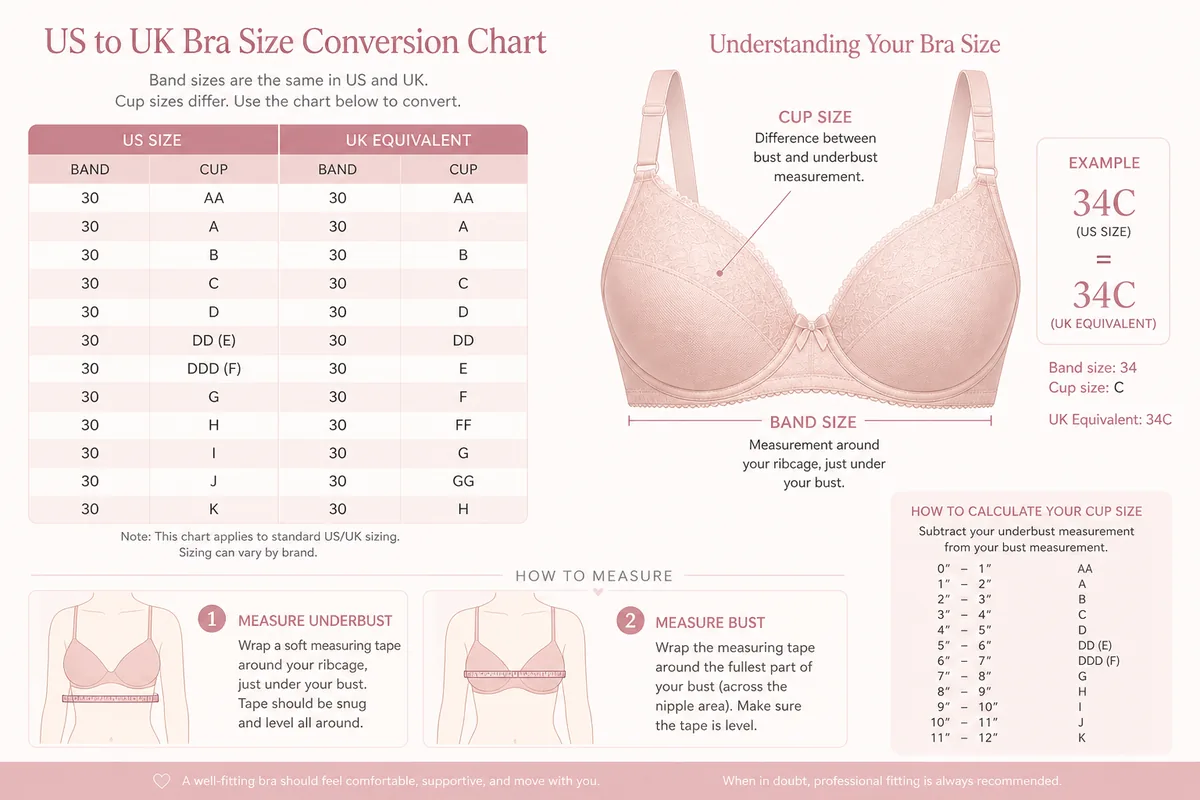
Quick answer
36C ≈ mid band + mid cup on that band (~3″; EU often ~80C). Sisters: 34D and 38B. Compare those when stock skips your exact tag or the band feels off.
| US / UK | EU (approx.) | Cup difference (chart) | Sister sizes |
|---|---|---|---|
| 36C | 80C | About 3" (≈8 cm) | 34D · 38B |
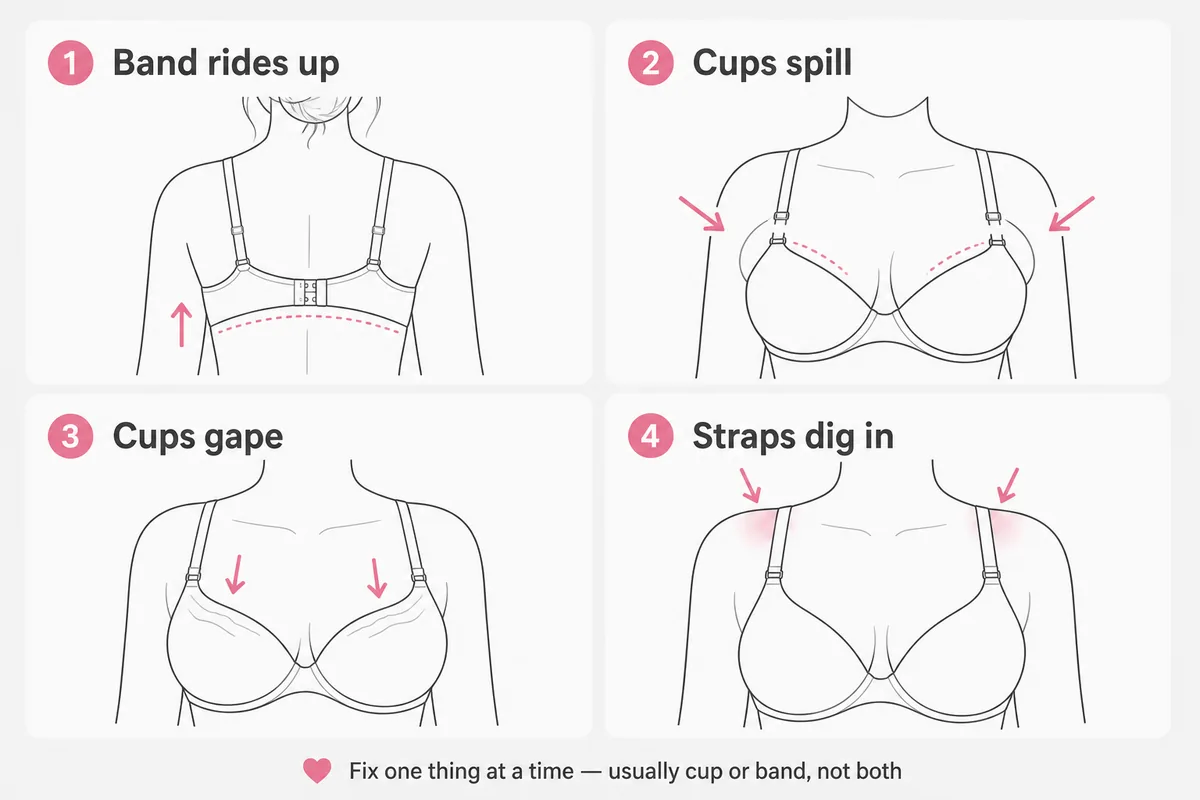
If this size feels wrong, try this next
Start from what you feel in the bra—not from a clothing size. Change one thing at a time: usually cup volume first if the band already stays level.
Band rides up
Try next: 34D sister
Keep volume; shorten band.
Cups spill; band fine
Try next: Higher cup on 36
Do not loosen the band to chase cup room.
Shoulder grooves
Try next: Snugger band story + wider straps
Straps are overworking.
Feels fine in mirror, bad by evening
Try next: Home wear test; check elastic age
Daytime stretch reveals true band fit.
Measure for 36C
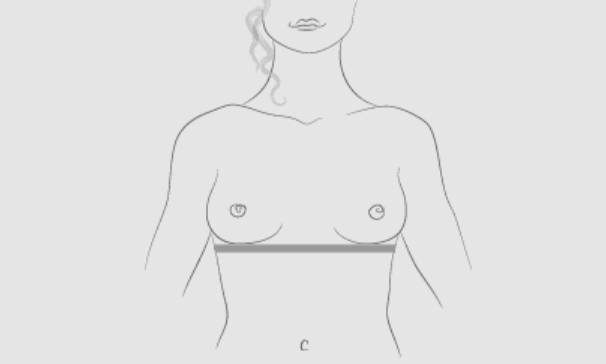
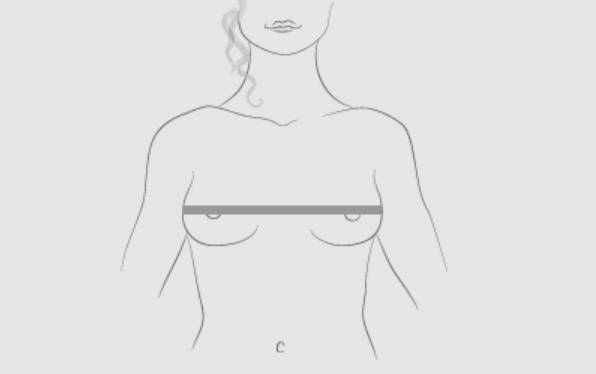
Soft tape, afternoon timing, skin-to-tape under the bust. Full illustrated steps: how to measure bra size.
- 1
Snug underbust
Tape firm under bust. Raw measure near 34–36 inches often maps to 36 band after rounding—confirm with hook feel.
- 2
Bust minus band
Near 3 inches suggests C cup on that band. Between 2 and 3? Try 36B and 36C together.
- 3
Scoop and sit test
Scoop tissue forward in trial bra, sit, and twist. 36C should not push band up or pinch under arms.
- 4
Sister confirmation
If 36C band rides up, test 34D. If hooks dig, test 38B before assuming you need 36D.
36C wear tests
- Band parallel to floor after 30 minutes seated.
- No spill in scoop-neck tops after proper scoop.
- Underwires on ribcage all the way to side.
- Center gore flat on sternum for wired bras.
- Straps without red marks when band is correct.
Before judging cups, scoop tissue fully into the cups (scoop & swoop).
Nearby sizes worth comparing
Same letter on a different band is not the same volume. Use these when you are between sizes or a style skips your label.
36B
One cup smaller
When C gaps throughout.
34C
Same letter, firmer band
When 36 never stays put.
38C
Same letter, wider band
When 36 digs after sister tests.
Sister sizes
34D / 38B
Band tension swaps.
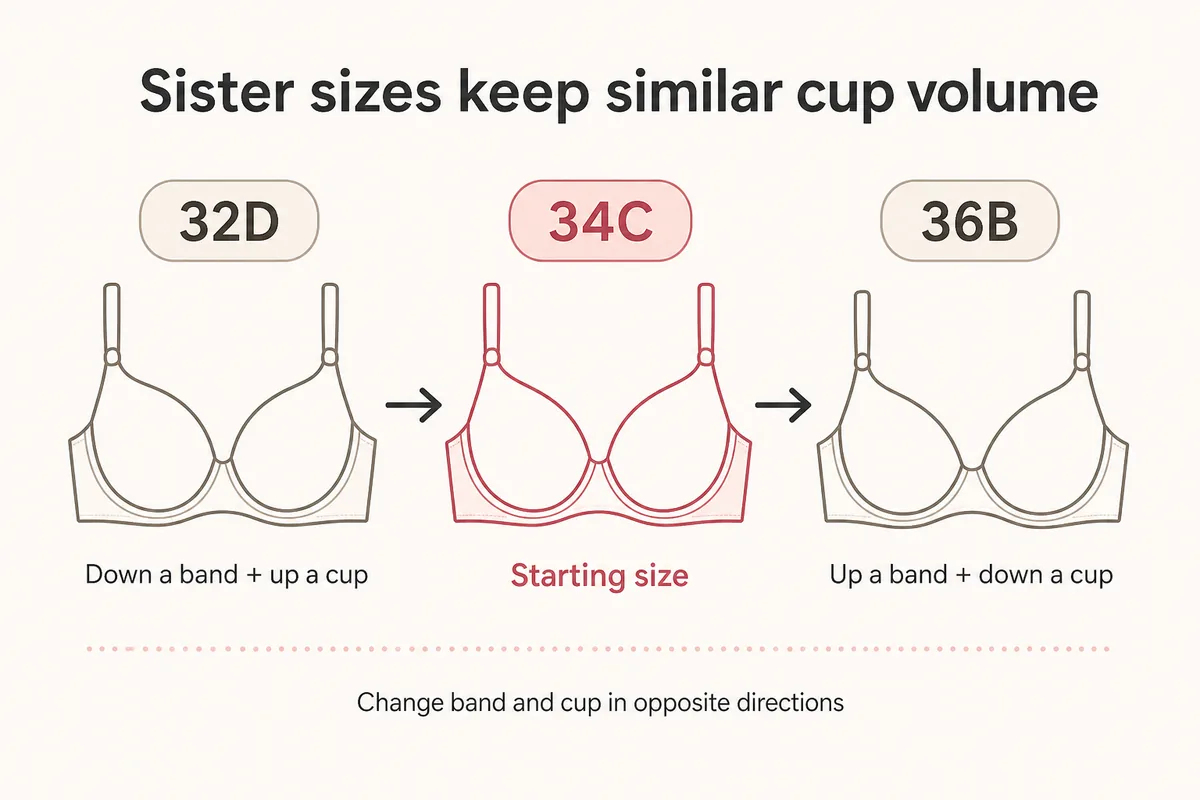
Sister sizes for 36C
Similar cup volume, different band tension. Full rule and chart: bra sister sizes.
- 34D
- 38B
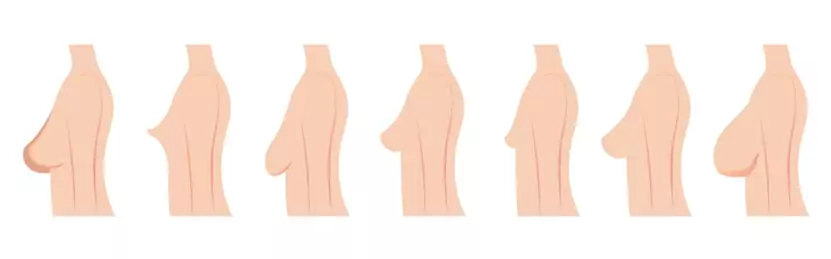
Same size, different shape
The label is volume on a band—not a body type. If the number seems right but the bra still fights you, cup shape is often the missing piece.
Tall molded cups often gape at the top. Try a shorter or demi cup before assuming the letter is too big.
Shallow t-shirt cups can flatten you even when the letter is right. Seamed or deeper cups usually feel truer.
A natural center gap is normal. Side-support panels help center the silhouette without forcing the gore.
Scoop fully into the cups first. Persistent empty space at the top often means cup shape, not a smaller letter.
The story behind 36C
36C is a workhorse size: enough band for a mid ribcage, enough cup for clear shape under clothes. It should feel quiet through a workday—not like you are constantly tugging.
C on a 36 band typically reflects a larger absolute cup volume than C on a 32, even though the letter matches. Keep the band number in every comparison.
If you recently moved from 34C because the band felt tight, confirm whether the cups were too small—tight cups can mimic a tight band.
EU charts often list something near 80C alongside US 36C. Match both parts when you order abroad.
Sister sizes 34D and 38B let you tune band tension without abandoning volume that already works.
Rotating two bras matters on a 36 band: the wings work hard, and tired elastic quietly turns a good size into a riding band.
Who wears 36C
Snug underbust commonly 32–35 inches with bust-minus-band near three inches. Postpartum rib expansion often lands people on 36C from 34C without much bust change.
Former 38B wearers with loose bands frequently drop to 36C for support. Former 34D wearers may rise to 36C for band ease—verify cups still fill.
36C spans many clothing sizes; do not infer bra from dress tag.
Everyday 36C habits
- Rotate at least two bras so elastic can recover; 36 bands work hard.
- For satin blouses, look for smoother cups; for knits, seamless works well.
- Side support panels help if tissue prefers to sit toward the underarm.
- Re-measure after training programs that change back or chest musculature.
- Sister 34D when band floats; sister 38B when hooks dig on loosest row.
- Hand-wash or lingerie bag extends life—36C everyday bras stretch out fast in dryers.
36C errors
Skip this: Upsizing to 38B when cups spill.
Try this instead: Try 36D on same band first.
Skip this: Assuming 36C equals plus bust.
Try this instead: 36 is band; C is relative volume—check fit signs, not labels.
Skip this: Loosening straps to fix band ride-up.
Try this instead: Fix band with 34D or tighter 36C hook row.
Sister sizes and nearby letters
Try 34D for a snugger band or 38B for more ease—both aim at similar volume.
Between sizes in the cup? Some brands 36C runs generous; others feel like a small D. Use return policies when shopping online.
Overflow at sides? 36D before 38C—keep band stable, increase letter.
Buying 36C bras
Mid bands and C cups are retail-friendly; projected shapes may need UK or full-bust brands.
Filter reviews for runs tight in band on 36—some lines fit more like 34.
EU 80C helps international shopping; still compare wire width photos in reviews.
How we approach bra sizing
SizeFit tools use bust-to-underbust difference for cup signals, aligned with European clothing size standard EN 13402. Measurement vocabulary follows ISO 8559 work under ISO/TC 133.
Band and cup differences follow classic inch steps used with our calculator—then confirm with a real wear test.
Brands still cut different shapes under the same stamp. Measure, use sister sizes when needed, and keep the bra that stays level through a normal day. Fit guidance—not medical advice.
Frequently asked questions
They are classic sister sizes with similar cup volume. Choose based on which band stays level on your back.
Straps are overworking—usually because the band is loose or the cups are too small. Tighten the band fit story before loosening straps all the way.
Most standard women's tops do. If button-fronts gap, consider a smoother cup or a bra with a lower center for that outfit—not necessarily a new size.
34D for a firmer band and 38B for a looser band with similar cup volume.
Choose D if C spills after scooping or wires sit on tissue; choose C if cups gape with a level band.
Related guides
Wearing a 36 Band With Confidence
A broader ribcage or an underbust in the mid-to-upper 30s often lands on 36—but grabbing 36 to “feel freer” when you actually need 34 plus more cup is a common trap that leaves the band riding up.
Fitting a 36B Without Guesswork
36B is easy to grab when you want a softer band. The risk is needing 34C instead: similar volume, firmer anchor. If the back rides up, treat that as a band clue before you write off the letter B.
Why 34C Feels Different From 34B
Moving from 34B to 34C often fixes spillage without touching the band—yet many people size up the band instead and lose the snug anchor they already had.
Sister Sizes Keep Cup Volume, Change the Band
When cups already sit well but the band digs or rides up, sister sizes let you change tension without throwing away the volume that worked. They are a fitting tool—not a reason to skip measuring.