
Why 34C Feels Different From 34B
Moving from 34B to 34C often fixes spillage without touching the band—yet many people size up the band instead and lose the snug anchor they already had.
Quick answer
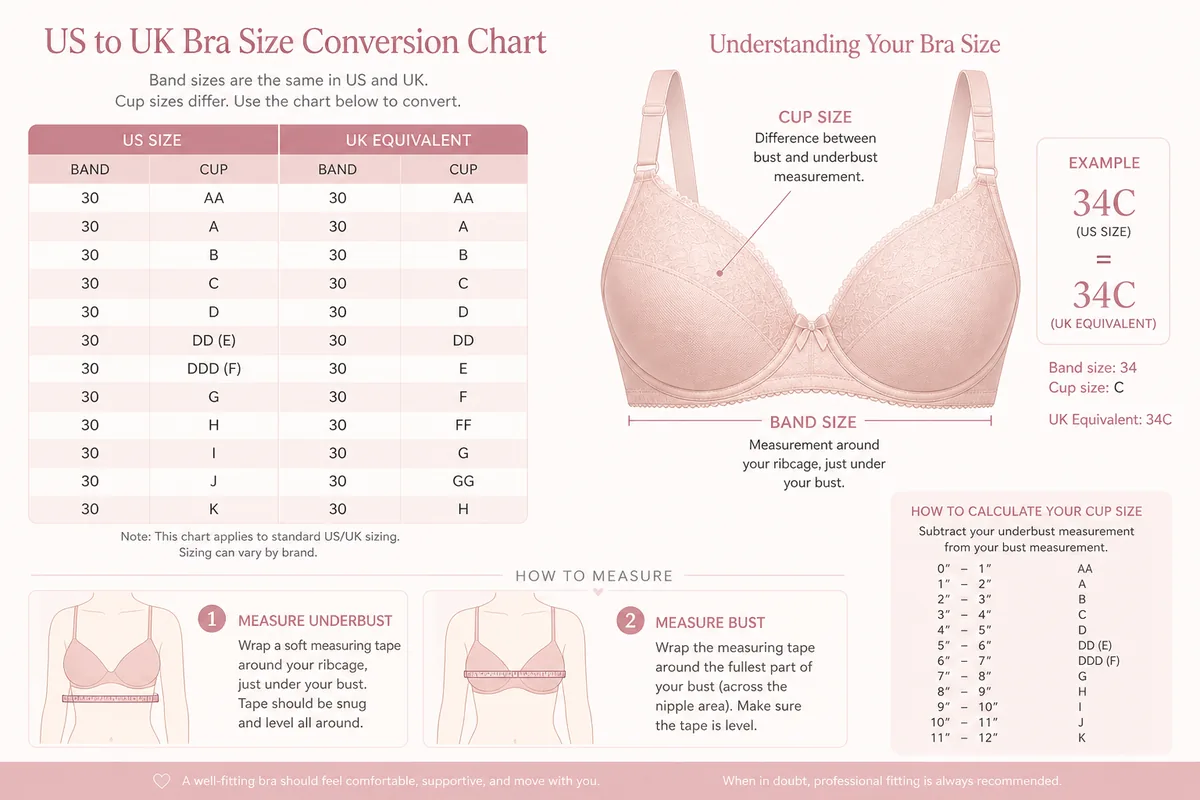
34C keeps a 34 band with more cup than 34B (~3″ on many charts; EU often ~75C). Sisters: 32D and 36B. Use those when cups fit but band tension does not.
| US / UK | EU (approx.) | Cup difference (chart) | Sister sizes |
|---|---|---|---|
| 34C | 75C | About 3" (≈8 cm) | 32D · 36B |
If this size feels wrong, try this next
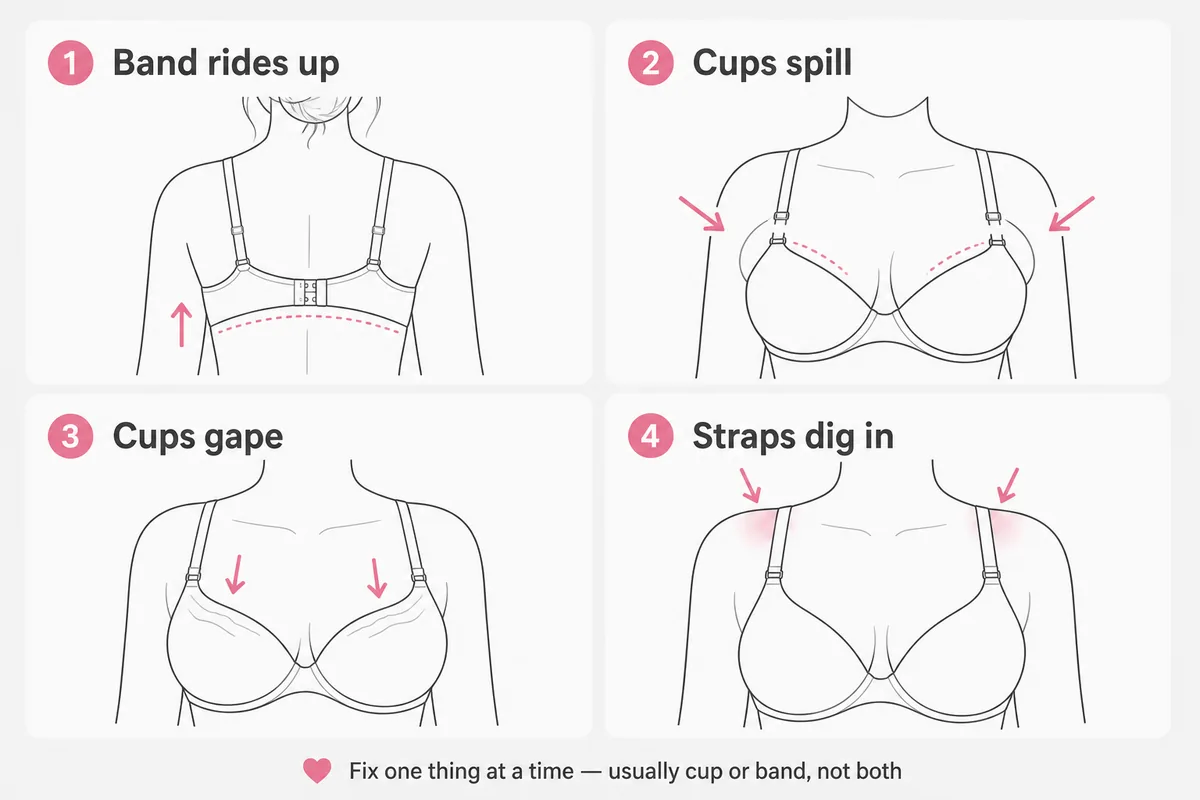
Start from what you feel in the bra—not from a clothing size. Change one thing at a time: usually cup volume first if the band already stays level.
Still spills at 34C
Try next: 34D / 34DD
Stay on the band that fits.
Band tight; cups good
Try next: 36B sister
Same volume, more rib ease.
Band loose; cups good
Try next: 32D sister
Same volume, firmer anchor.
Gore floats
Try next: Deeper cup shape or more volume
Floating gore rarely means “go to 36C” first.
Measure for 34C
Soft tape, afternoon timing, skin-to-tape under the bust. Full illustrated steps: how to measure bra size.
- 1
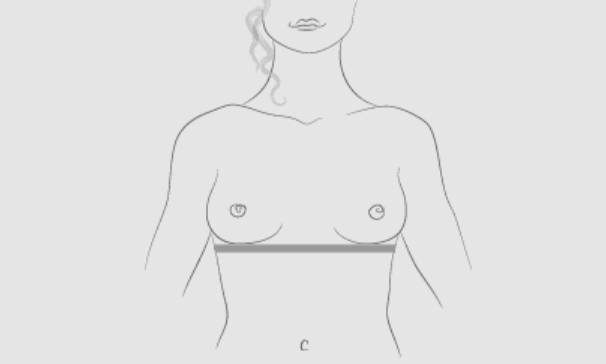
Underbust snug
Measure level under the bust. Round to 34 if raw snug measure sits near 32–34 inches—confirm with how hooks feel, not vanity.
- 2
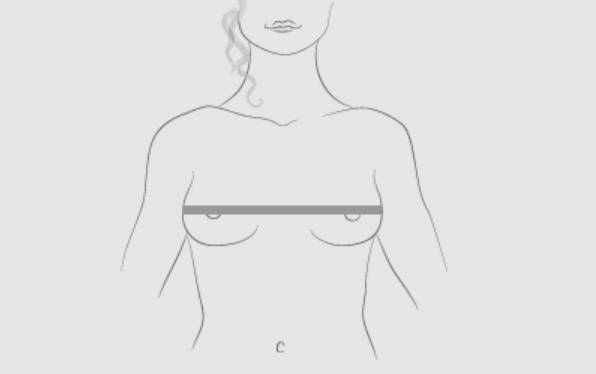
Bust at fullest
Use standing and optionally leaning bust for soft tissue. Subtract underbust; near 3 inches suggests C on many US charts.
- 3
Validate letter with trial
Try 34B and 34C side by side. C should eliminate spill without empty space at the top after scooping.
- 4
Check sisters if band off
If 34C cups fit but band rides up, try 32D. If hooks dig on loosest row, try 36B before 34D.
34C fit checklist
- No spill at neckline or armpit after forward scoop.
- Band stays level when you reach overhead.
- Gore touches sternum on underwire styles.
- Cup edge smooth under a fitted tee—no quad-boob.
- Straps mid-adjustment without carrying full breast weight.
Before judging cups, scoop tissue fully into the cups (scoop & swoop).
Nearby sizes worth comparing
Same letter on a different band is not the same volume. Use these when you are between sizes or a style skips your label.
34B
One cup smaller
When 34C is roomy after scooping.
34DD
Fuller on same band
When C still quads.
36C
Same letter, wider band
When every 34 digs.
Sister sizes
32D / 36B explained
Stock or tension issues.
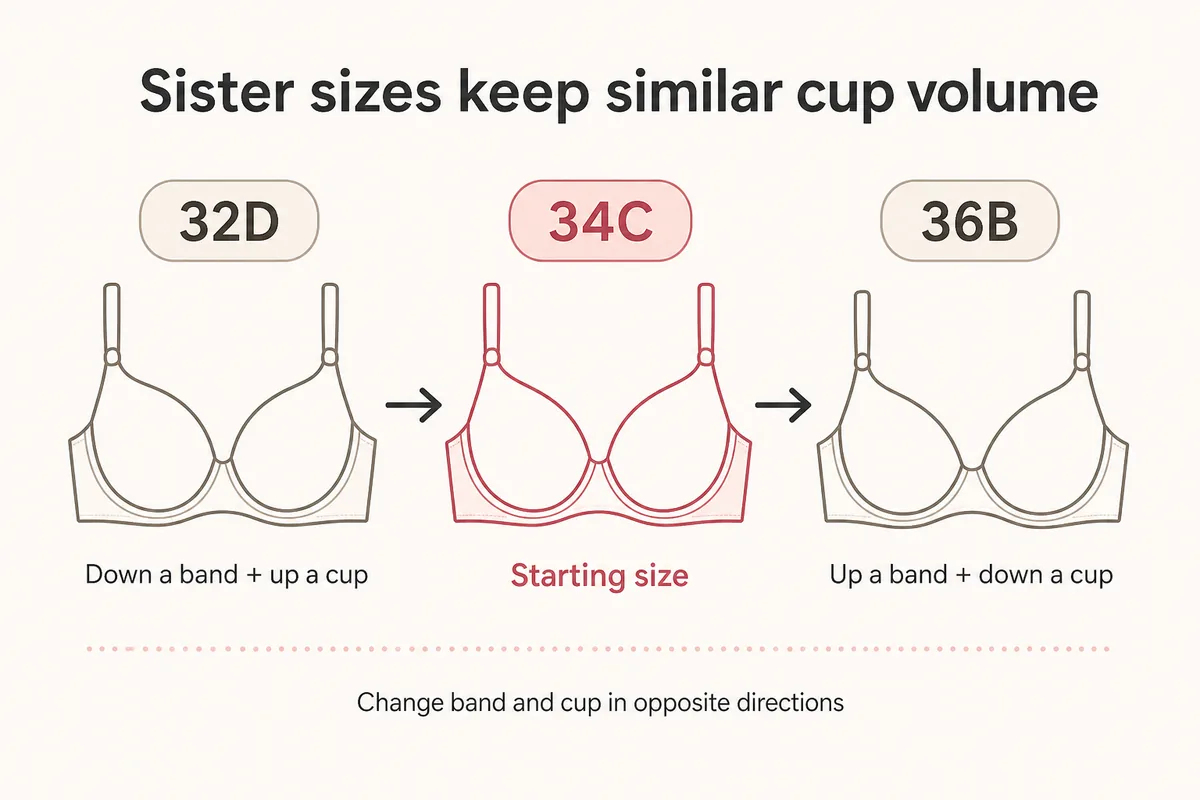
Sister sizes for 34C
Similar cup volume, different band tension. Full rule and chart: bra sister sizes.
- 32D
- 36B
Same size, different shape
The label is volume on a band—not a body type. If the number seems right but the bra still fights you, cup shape is often the missing piece.
Tall molded cups often gape at the top. Try a shorter or demi cup before assuming the letter is too big.
Shallow t-shirt cups can flatten you even when the letter is right. Seamed or deeper cups usually feel truer.
A natural center gap is normal. Side-support panels help center the silhouette without forcing the gore.
Scoop fully into the cups first. Persistent empty space at the top often means cup shape, not a smaller letter.
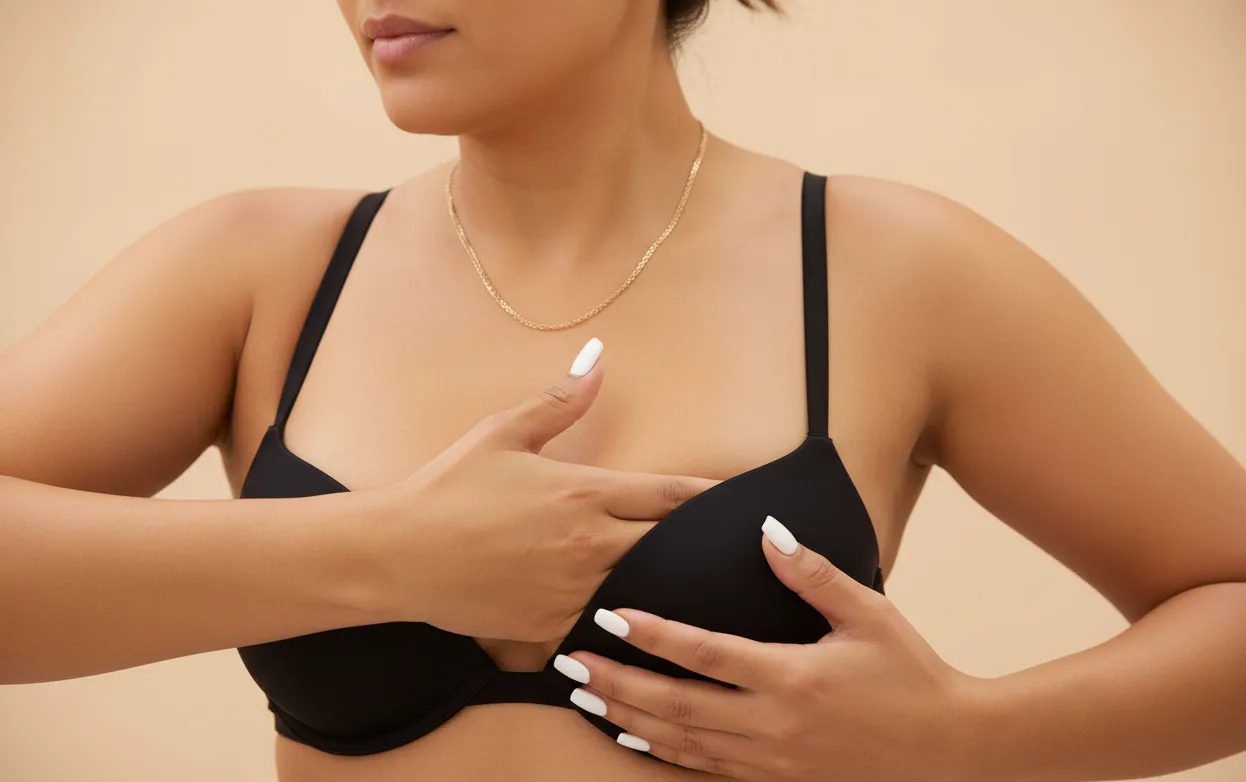
What changes when the letter becomes C
You should notice more room at the apex and sides while the 34 band still anchors the bra. If the band loosens when you size up the cup, the cups were probably forcing the bra out of place before.
C on 34 is not the same absolute volume as C on 38. Always keep the band number in mind when comparing sizes with friends or reviews.
EU labels may show near 75C. Some brands print E for what others call DD—less of an issue at C, but still verify on international tags.
34C is a frequent post-measurement destination for former 34B or 32D wearers. The band stays; only the letter moves—support often improves immediately.
Wire length matters at C cup: too-short wires cause side spill that feels like you need a bigger band when you need longer cups on the same 34.
Sister sizes 32D and 36B preserve volume when 34C cups fit but hooks feel wrong—use them before jumping to 34D or 36C simultaneously.
Who 34C fits well
Snug underbust near 32–34 inches with bust-minus-band around three inches is the classic starting point. Many adults measure here after correcting a too-loose 36B.
Nursing and hormonal cycles can temporarily need 34C even when 34B fit last month—stretch cups or sister 36B help without abandoning the size.
Athletic builds with moderate projection often settle on 34C when 34B quadded or spilled despite a stable band.
Dialing in a 34C fit
- Balconette and plunge shapes can fit 34C beautifully if you are fuller on top—full-coverage cups help if you are fuller on bottom.
- Underwire length should encircle tissue; short wires cause side spill that looks like a need bigger band problem.
- Try the same bra in 34B and 34C when possible; the better cup often makes the band feel more stable.
- Nursing or fluctuating size? Keep 34C as a midpoint and use stretch cups or sisters.
- Log brands that run shallow—34C in one line may feel like 34B in another.
- Replace when gore lifts even on fresh scoop—elastic or cup size may be spent.
34C mistakes
Skip this: Moving to 36B when 34C cups feel tight.
Try this instead: Try 34D on the same band—looser bands mask cup issues.
Skip this: Assuming C means full bust only.
Try this instead: C is relative to band; 34C volume differs from 38C.
Skip this: Ignoring sister 32D when band floats.
Try this instead: Firmer band often fixes spill without new cup volume.
If 34C is in the ballpark
Sisters: 32D and 36B for band changes with similar volume.
Still quadding at the neckline? 34D. Empty space at the top after scooping? Re-check shape or try 34B.
Between 34C and 34D in one brand? Try both—grading differs more than charts suggest.
Buying 34C bras
34C is widely stocked but cup depth varies wildly—read reviews for runs shallow if you are projected.
Keep sister sizes handy for sales racks missing 34C—32D and 36B expand options.
EU 75C conversion helps abroad; UK brands may use different wire shapes on the same label.
How we approach bra sizing
SizeFit tools use bust-to-underbust difference for cup signals, aligned with European clothing size standard EN 13402. Measurement vocabulary follows ISO 8559 work under ISO/TC 133.
Band and cup differences follow classic inch steps used with our calculator—then confirm with a real wear test.
Brands still cut different shapes under the same stamp. Measure, use sister sizes when needed, and keep the bra that stays level through a normal day. Fit guidance—not medical advice.
Frequently asked questions
They are sister sizes. Cup volume is meant to be similar; 34C is firmer on the ribs, 36B is easier. Neither is universally bigger.
Band relates to underbust; C often aligns with about a 3-inch bust-minus-underbust difference on traditional US charts. Shape still decides how a given bra fills.
You may prefer firmer wings or a denser knit simply because there is more tissue to hold, but the rules are the same: stable band, encapsulated cups for impact, straps as helpers.
32D (tighter band, larger cup letter) and 36B (looser band, smaller cup letter) with similar volume.
When 34C spills after scooping, wires sit on tissue, or gore floats despite a level band—move one cup letter before changing band.
Related guides
34 Bra Size: Band Fit & Common Cups
Because 34 is everywhere in US stores, many people wear “34-something” out of habit. If bras feel loose in the back or empty in the cups, the band number may be right while the letter—or the reverse—is wrong.
Making Sense of 34B
34B shows up on more hangers than almost any other size—which is why it is both a genuine fit for many and a default guess for people who never measured. If it “never feels right,” change one variable at a time.
Owning a True 34DD Fit
Plenty of people discover 34DD only after leaving a too-small 34C/D or a stretched 36. The win is keeping a common band while admitting the cup volume you actually need.
Living Comfortably in 36C
36C is a workhorse under everyday clothes: enough band for a mid ribcage, enough cup for shape. Absolute “C means medium” myths fail here—letter C is volume on a 36, not a personality trait.