SizeFit logoSizeFit

Baby & Kids Shoe Size Chart & Converter

From tiny infant booties to toddler walking shoes, find the perfect fit. Our chart and converter cover US, UK, and EU sizes based on accurate foot measurements.

Children's feet grow rapidly, so accurate sizing is crucial for comfort and healthy foot development. Our converter uses foot length measurements to provide accurate conversions across all international standards.

How to Use This Kids Shoe Size Converter

Step-by-Step Guide

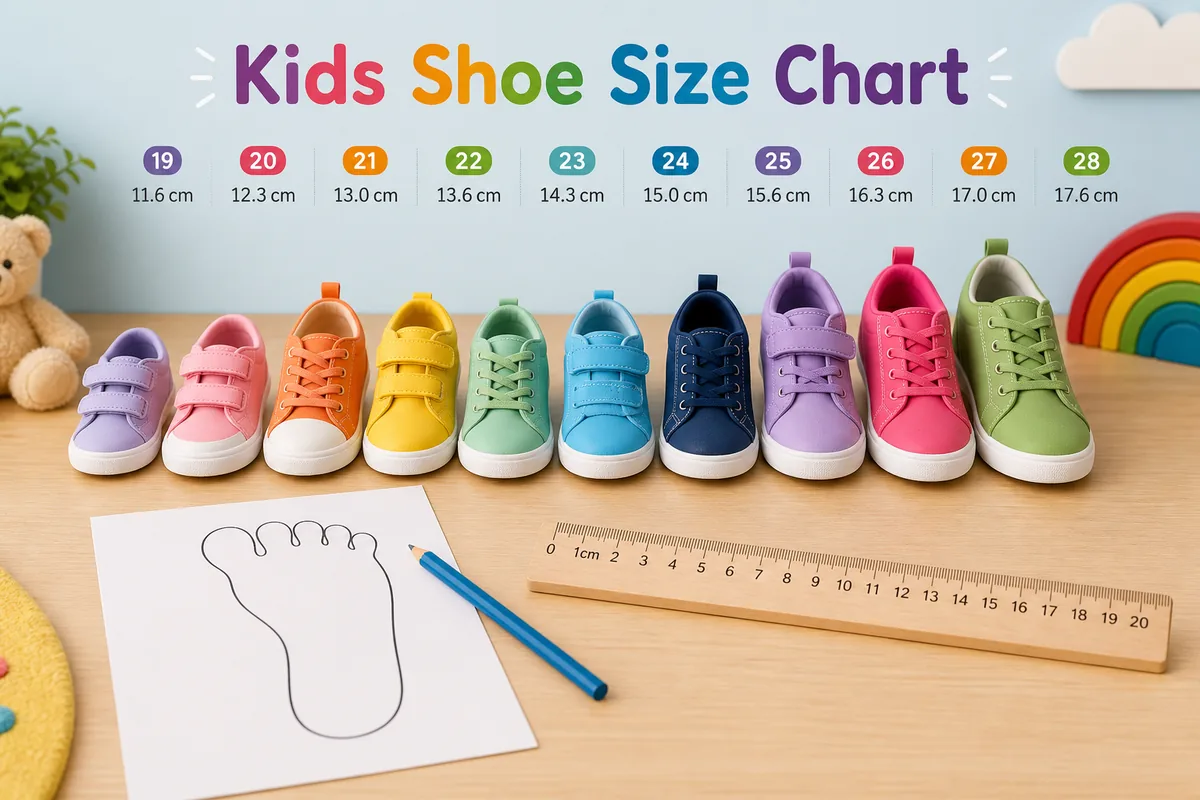
  1. Measure Your Child's Foot: Have your child stand on a piece of paper. Mark the back of their heel and the tip of their longest toe. Measure the distance in centimeters for the most accurate result.
  2. Select the Age Category: Choose whether you're converting infant/toddler sizes (marked with 'C') or youth sizes (marked with 'Y'). This is important because the size scales differ.
  3. Select Your Size System: Choose the size system you know your child's size in (US, UK, EU, or CM).
  4. Enter the Shoe Size: Enter your child's current shoe size. For infant/toddler sizes, include the 'C' suffix if applicable (e.g., 4C). For youth sizes, include the 'Y' suffix if applicable (e.g., 1Y).
  5. View Converted Sizes: The converter will display your child's equivalent size in other international standards, helping you shop for shoes from different countries with confidence.

Important Tips for Kids Shoe Sizing

  • Measure Regularly: Children's feet grow quickly, especially during growth spurts. Re-measure every 3-4 months to ensure proper fit.
  • Measure Both Feet: Children's feet can differ slightly in size. Always measure both feet and use the larger measurement.
  • Leave Room for Growth: Allow about 0.5-1 cm (0.2-0.4 inches) of extra space for growth, but not too much as it can affect walking and cause tripping.
  • Measure in the Afternoon: Feet are typically larger in the afternoon, so measure at this time for the most accurate sizing.
Kids Shoe Size Converter

Input a size in any standard to see all international conversions instantly.

Generic / Standard - Kids' Shoe Sizes

USUKEUJPCM
1C0.5169.19.1
2C1.5171010
3C2.518.510.810.8
4C3.519.511.611.6
5C4.52112.512.5
6C5.52213.313.3
7C6.523.514.214.2
8C7.5251515
9C8.52615.915.9
10C9.52716.716.7
10.5C1027.517.217.2
11C10.52817.617.6
11.5C1128.51818
12C11.529.518.418.4
12.5C123018.818.8
13C12.53119.319.3
13.5C1331.519.719.7
113.53220.120.1
1.513320.520.5
21.533.520.920.9
2.523421.421.4
32.53521.821.8
3.5335.522.222.2
43.53622.422.4
4.5436.522.722.7
54.537.523.223.2
5.553823.523.5
65.538.523.823.8
6.563924.324.3
764024.624.6

A Note on Sizing Accuracy

Children's shoe sizes can be particularly confusing as they grow. The conversion data in this tool is based on publicly available information aligned with the ISO 19407 standard.

For a comprehensive overview and detailed charts, we reference the information available on Wikipedia's Shoe Size page. This helps ensure our converter provides a reliable baseline for your needs.

Why Choose Our Kids Shoe Size Converter?

Complete Size Range

Our charts cover the full spectrum of children's footwear, from infant and baby sizes (C-sizes) to youth sizes (Y-sizes) for older kids.

Five International Standards

Supports US, UK, EU, JP, and CM sizing standards, meeting global shopping needs for children's footwear.

Professional Measuring Guide

Detailed foot measurement methods and buying advice to ensure you choose the most comfortable and suitable shoes for your child.

Data-Driven Accuracy

Our conversion data is based on international standards and leading brand data (like Nike) to provide the most reliable conversions possible.

Kids Shoe Buying Guide

Best Time to Measure

Measure your child's feet in the afternoon or evening when feet are slightly swollen, which is closer to the actual state when wearing shoes.

Growth Room

Children's feet grow quickly, so leave 0.5-1cm of growing room. But don't buy shoes too large, as this can affect your child's normal walking.

Material Selection

Choose breathable materials with appropriate softness. Avoid soles that are too hard or too soft, ensuring good support for children's foot development.

Regular Checks

Re-measure your child's foot length every 3-4 months and replace ill-fitting shoes promptly to ensure healthy foot development.

Kids Shoe Size Conversion FAQ

Q: How to accurately measure children's foot length?

A: Have your child stand on paper with their heel against the wall, mark the longest toe with a pen, then measure the distance from heel to mark with a ruler. Measure both feet and take the larger value. It's recommended to measure in the afternoon when feet are slightly swollen.

Q: Should I buy children's shoes one size larger?

A: It's recommended to leave 0.5-1cm of growing room, but don't buy shoes that are too large. Oversized shoes can affect your child's normal walking and may even cause foot development problems. The best practice is to measure regularly and replace shoes as needed.

Q: Do different brands have different children's shoe sizes?

A: Yes, different brands may have size variations. It's recommended to check the brand's specific size chart before purchasing, or use our foot length (CM) data to choose the most suitable size.

Q: How often should I re-measure my child's foot length?

A: It's recommended to re-measure every 3-4 months. Children's feet develop very quickly, especially during growth spurts. Regular updates to foot length data help in selecting appropriate shoe sizes.

Understanding Kids' Shoe Sizes: Infant, Toddler, and Youth

Finding the right shoe size for a child can be tricky as their feet grow so quickly. Kids' shoe sizes are typically divided into three main categories: Infant, Toddler, and Youth (or 'Grade School'). Our converter and charts below cover all these stages to help you find the perfect fit.

Infant & Toddler Sizes (Marked with 'C')

Sizes for the youngest children, from newborns to toddlers, are usually marked with a "C" after the number (e.g., 4C, 9.5C). This range typically covers babies and children up to about 5 years old. Our "Infant & Toddler" chart above provides a full conversion for these sizes.

Youth Sizes (Marked with 'Y')

Once a child outgrows the "C" sizes (around size 13.5C), they move into "Youth" or "Grade School" sizes. This scale starts over from 1 and is often marked with a "Y" (e.g., 1Y, 5.5Y). This range is for older children, and the largest youth sizes can sometimes overlap with smaller adult sizes. See the "Youth" chart above for conversions.

How to Get the Best Measurement

For the most accurate sizing, we recommend measuring your child's foot in centimeters (CM). Have them stand on a piece of paper, mark the back of their heel and the tip of their longest toe, and then measure the distance. You can input this CM value directly into our converter for a precise result. Check out our full guide on measuring shoe size for more details.