
Support Starts With a True 38 Band
Wider bands get judged unfairly. A well-fitted 38 should feel quietly supportive under tees—not like a costume size. When it fails, people often change the letter when the band tension was the real issue.
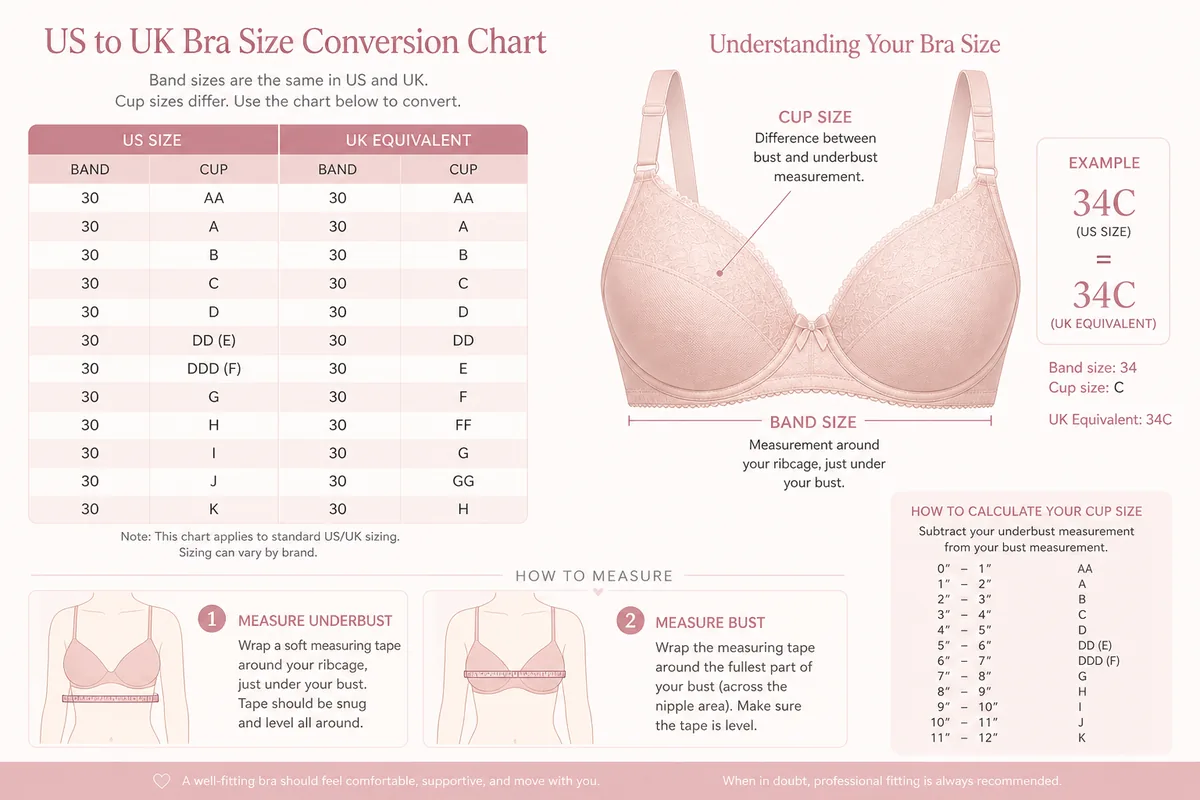
Quick answer
38 is about underbust circumference (EU often ~85), not a body type. Pair it with the cup your difference needs. Prefer a level band on a looser hook over a looser band that rides up by noon.
US / UK band: 38 · EU (approx.): 85
Pair with a cup letter for volume. The letter is relative to this band—not a clothing size.
If this size feels wrong, try this next
Start from what you feel in the bra—not from a clothing size. Change one thing at a time: usually cup volume first if the band already stays level.
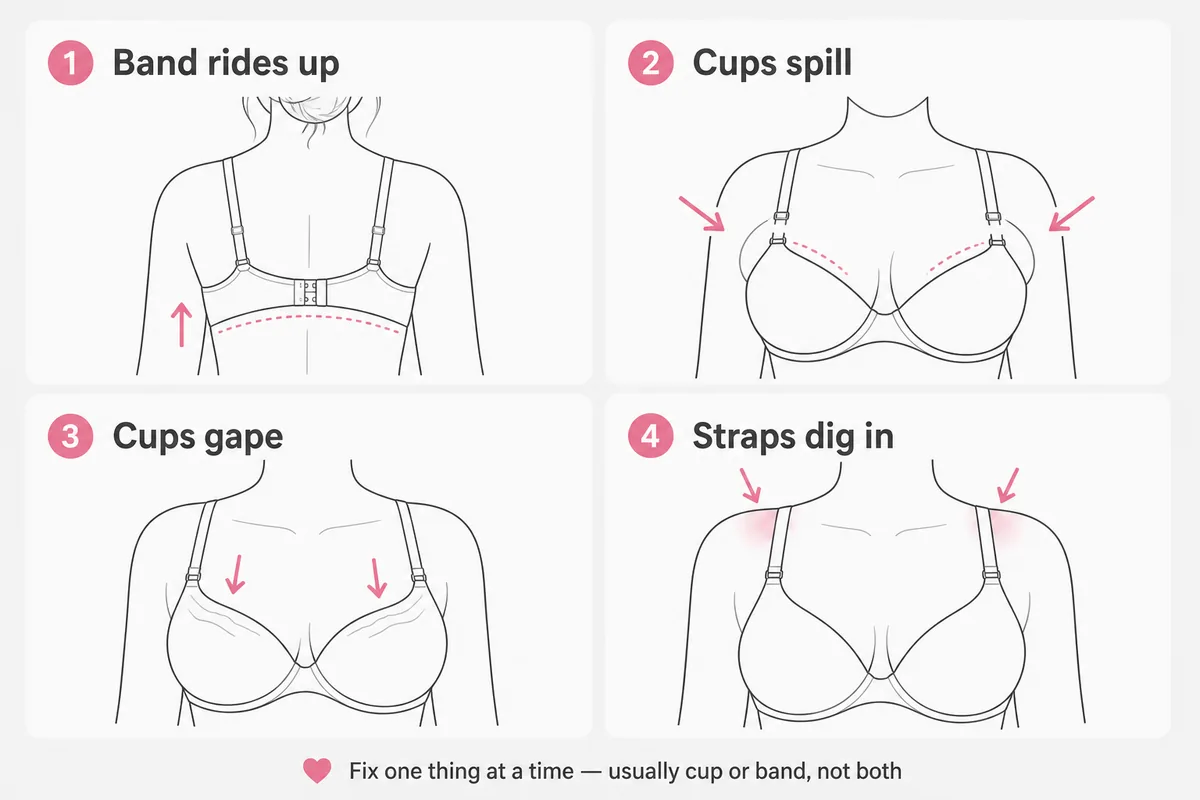
38 rides up; cups overflow
Try next: Stay on 38; increase cup letter
Sizing to 40 for “more cup” often loosens the only support you had.
38 digs even on loosest hook
Try next: Recheck underbust measure; then sister up a band with smaller cup
Measuring over clothes commonly underestimates ease.
Shoulders hurt in every 38
Try next: Wider straps + confirm band snugness
Painful straps usually mean the band is not sharing load.
Sports bras bounce too much
Try next: Encapsulation style with a defined 38 band
Compression-only crops struggle on wider bands with fuller cups.
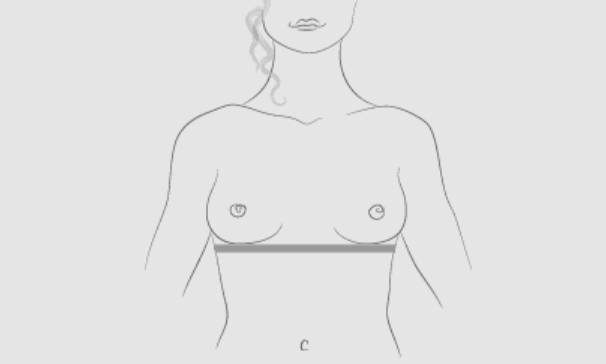
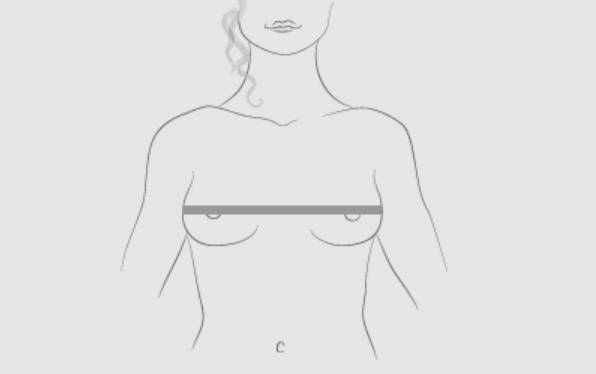
Measuring for 38
Soft tape, afternoon timing, skin-to-tape under the bust. Full illustrated steps: how to measure bra size.
- 1
Underbust without adding inches
Pull tape snug under the bust. Do not add two inches for comfort—the bra provides stretch. If you measure 37 snug, 38 is a reasonable first try.
- 2
Bust over clothing vs bare
Measure bust on bare skin or a thin unpadded top. Padded sweaters skew cup letters upward and push people into loose bands.
- 3
Check wire placement on trial bras
When trying 38, ensure underwires sit in the inframammary fold all the way to your side. Wires too short mimic need for 40.
- 4
Move before deciding
Sit, reach, and walk before approving a 38. Wider bands show problems late—back riding up often appears after ten minutes, not in static mirror checks.
38-band wear tests
- Band parallel to floor when viewed from the side in a mirror.
- No skin spillover at the back wings under a t-shirt.
- Underwire tips do not poke armpit tissue forward.
- Hooks fasten on loosest or middle row with secure feel.
- Cup neckline lies smooth after scoop-and-swoop without gaping or cutting in.
Before judging cups, scoop tissue fully into the cups (scoop & swoop).
Nearby sizes worth comparing
Same letter on a different band is not the same volume. Use these when you are between sizes or a style skips your label.
38C
Practical everyday pairing
When the band fits and you need mid cup volume.
36 band
Firmer sister family
When 38 never stays level.
Sister sizes
Volume-preserving swaps
When cups fit but band tension is wrong.
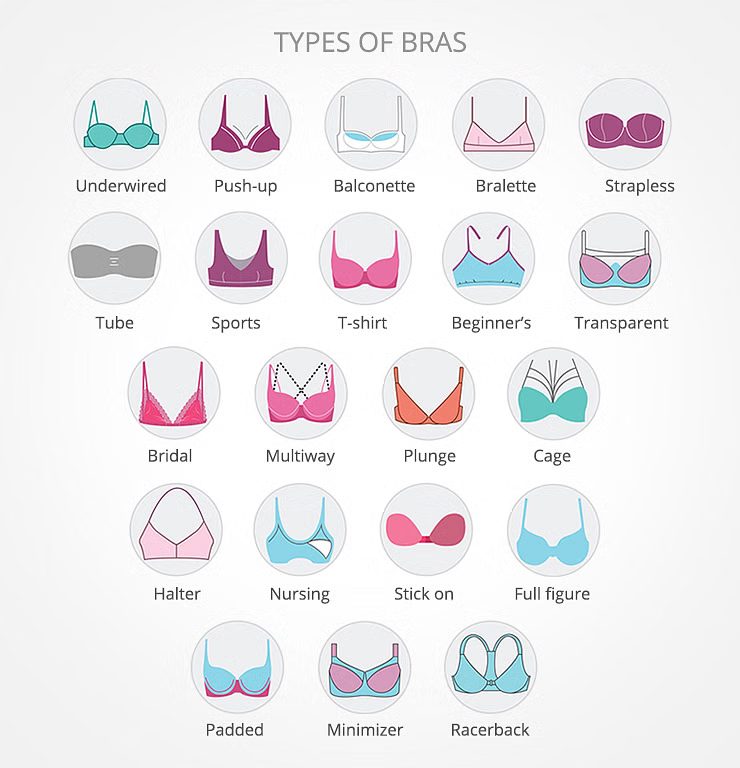
Same size, different shape
The label is volume on a band—not a body type. If the number seems right but the bra still fights you, cup shape is often the missing piece.
Tall molded cups often gape at the top. Try a shorter or demi cup before assuming the letter is too big.
Shallow t-shirt cups can flatten you even when the letter is right. Seamed or deeper cups usually feel truer.
A natural center gap is normal. Side-support panels help center the silhouette without forcing the gore.
Scoop fully into the cups first. Persistent empty space at the top often means cup shape, not a smaller letter.
Common cups on a 38 band
Why the 38 number matters
Wider bands distribute pressure across more of the back. If you have been sizing up every time cups felt small, you may be in a loose 40 with overflowing cups—try 38 with a larger letter instead.
Extended-cup brands often shine at 38 because they cut proper D–DDD volumes instead of forcing everyone into shallow shapes designed for smaller frames.
EU charts commonly list something near 85 for a 38 band. Match the letter carefully; markets disagree on DD vs E naming and that confusion grows with cup size.
A 38 band should not feel like a sash you tighten until it hurts. Snug on the loosest hook with two-finger ease under the center is the target; pain means wrong size or wrong style, not weak willpower.
Cup letters from 38A through 38DD+ share the same band anchor but wildly different wire lengths. Compare 38C to 38D by volume needs, not by assuming C is always moderate.
Sports and everyday bras share the same band rules: if the 38 rides up in a jog, tightening straps will not fix a loose band or too-small cups.
Who commonly wears 38
Snug underbust near 34–37 inches (about 86–94 cm) often maps to 38 after even rounding, especially with softer ribcage tissue. Shoulders and back width do not dictate band alone—underbust tape does.
People exiting poorly fitted 40D bras frequently discover 38DD or 38C fits better once tissue is scooped into cups sized for the smaller, firmer band.
Menopause, medication-related weight shift, and core strength changes can move someone from 36 to 38 without a dramatic bust change—only the ribcage circumference moved.
Comfort checks unique to wider bands
- Look for firm wing elastic; thin stretchy bands collapse on larger ribcages.
- Side boning can help keep a 38 smooth under tops without feeling medical.
- Try the two-finger ease under the front band—snug, not gasping.
- If hooks leave deep marks but the band still rides up, cups may be too small.
- Racerback clips help straps stay put on broader shoulders without over-tightening.
- Prioritize encapsulation in sports bras—compression-only crops often fail on 38 with fuller cups.
38-band errors
Skip this: Jumping to 40 when 38 hooks feel firm.
Try this instead: Firm is correct on a new bra—try larger cup on 38 before upsizing band.
Skip this: Assuming 38C is automatically a large bust.
Try this instead: 38 is band; C is relative volume on that band—different from 32C in absolute tissue.
Skip this: Ignoring sister 36D when 38C band feels loose.
Try this instead: 36D keeps volume with a firmer anchor—often fixes ride-up.
Alternatives around 38
Sister down for more security: 36D often pairs with 38C for similar volume.
If 38 feels crushing even on the loosest hook, confirm your underbust measure before jumping to 40—measurement over bulky clothing is a common error.
Overflow in 38C with stable band? Try 38D or sister 36DD depending on brand cup ladder.
Buying in a 38 band
Plus and full-bust brands often start extended cups at 38; mall lines may stop at D. Filter D+ on the same band before abandoning 38.
Hook-and-eye rows with four hooks can improve comfort on wider bands—worth seeking in everyday bras.
International EU 85 sizing helps, but open the schematic: cup depth and wire width vary more than the number on the tag.
How we approach bra sizing
SizeFit tools use bust-to-underbust difference for cup signals, aligned with European clothing size standard EN 13402. Measurement vocabulary follows ISO 8559 work under ISO/TC 133.
Band and cup differences follow classic inch steps used with our calculator—then confirm with a real wear test.
Brands still cut different shapes under the same stamp. Measure, use sister sizes when needed, and keep the bra that stays level through a normal day. Fit guidance—not medical advice.
Frequently asked questions
38 describes the band; C describes relative cup depth on that band. Volume is different from a 32C. Focus on whether tissue is contained and the band stays put.
High-impact styles still rely on a firm band. Encapsulated cups often feel more stable than thin compression alone when you are on a 38 with fuller cups.
Common neighbors are 36D (tighter band, larger cup letter) and 40B (looser band, smaller cup letter). Try those when the cup volume is right but the band is not.
Many fashion lines grade out early cups on 38. Specialty retailers and sister sizing expand options—36D or 40B may unlock the same look.
Snug on the loosest hook with two fingers under the center band. It should not bruise or restrict breathing. Tighten hooks as the bra ages, not the reverse on day one.
Related guides
Finding Ease and Lift in 38C
38C should feel quietly supportive under button-downs—not like you “settled” for a wide band. Focus on whether the band stays level; the letter C alone is not small or large.
Wearing a 36 Band With Confidence
A broader ribcage or an underbust in the mid-to-upper 30s often lands on 36—but grabbing 36 to “feel freer” when you actually need 34 plus more cup is a common trap that leaves the band riding up.
Sister Sizes Keep Cup Volume, Change the Band
When cups already sit well but the band digs or rides up, sister sizes let you change tension without throwing away the volume that worked. They are a fitting tool—not a reason to skip measuring.
DD vs DDD: Double D, Triple D & Letter Chart
DD and DDD are steps on a cup ladder, not a separate sizing universe. Confusion usually comes from tags that print E/F for the same steps—or from UK charts that place E differently.