
Fitting 32DD Without Settling
32DD is a real measured size—narrower ribs with fuller cups—not a contradiction. People often bounce to 34D for “easier shopping” and then fight a band that will not stay down.
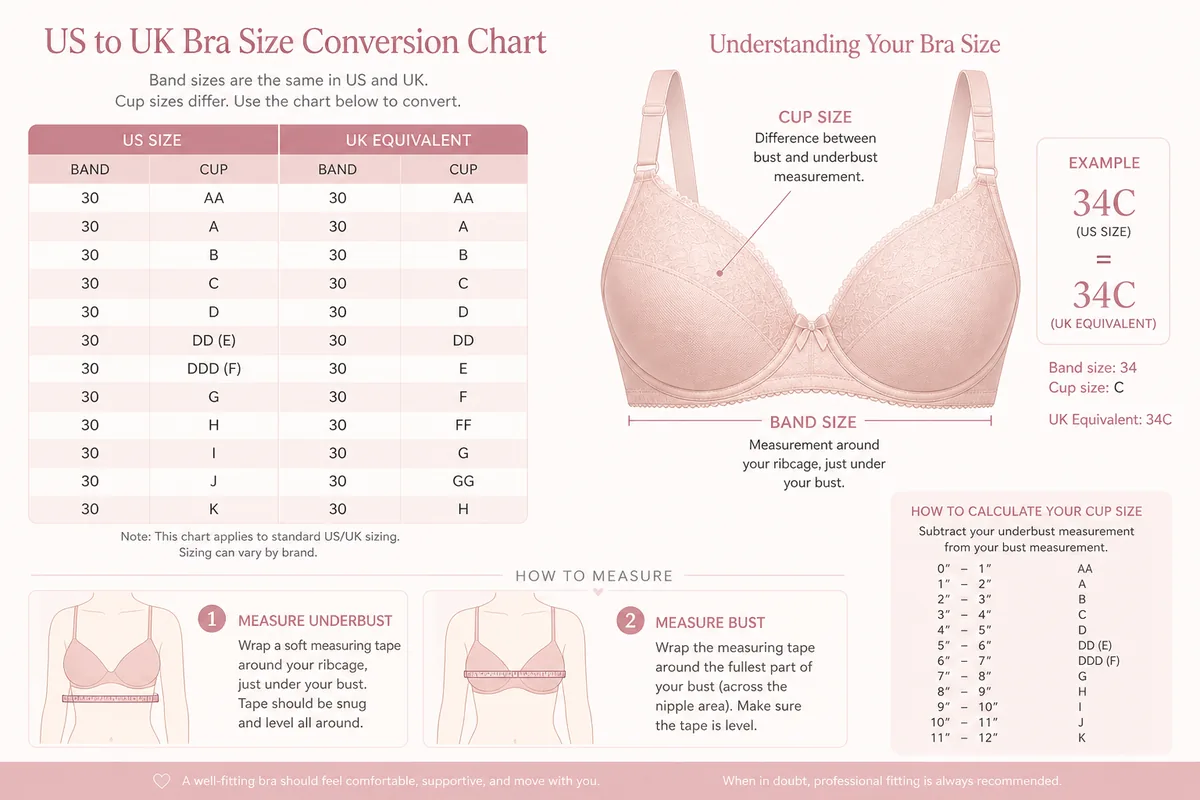
Quick answer
32DD ≈ fuller cup on a 32 band (~5″ on many US charts; often also labeled E; EU may show ~70E). Sisters: 30E/F* and 34D. Prefer specialty 32DD over a looser band that only fits the cup letter.
| US / UK | EU (approx.) | Cup difference (chart) | Sister sizes |
|---|---|---|---|
| 32DD | 70E | About 5" (≈13 cm) | 30DDD · 34D |
If this size feels wrong, try this next
Start from what you feel in the bra—not from a clothing size. Change one thing at a time: usually cup volume first if the band already stays level.
Spill after scooping; band perfect
Try next: 32DDD/F if offered
Next volume step beats a loose 34.
No 32DD in stock
Try next: 34D sister
Similar volume; reassess band feel.
Underwire on tissue at the side
Try next: Longer wire / side sling style
Root width, not “wrong letter” alone.
Sports bra lacks control
Try next: Encapsulation high-support on 32
Thin compression rarely replaces cup depth.
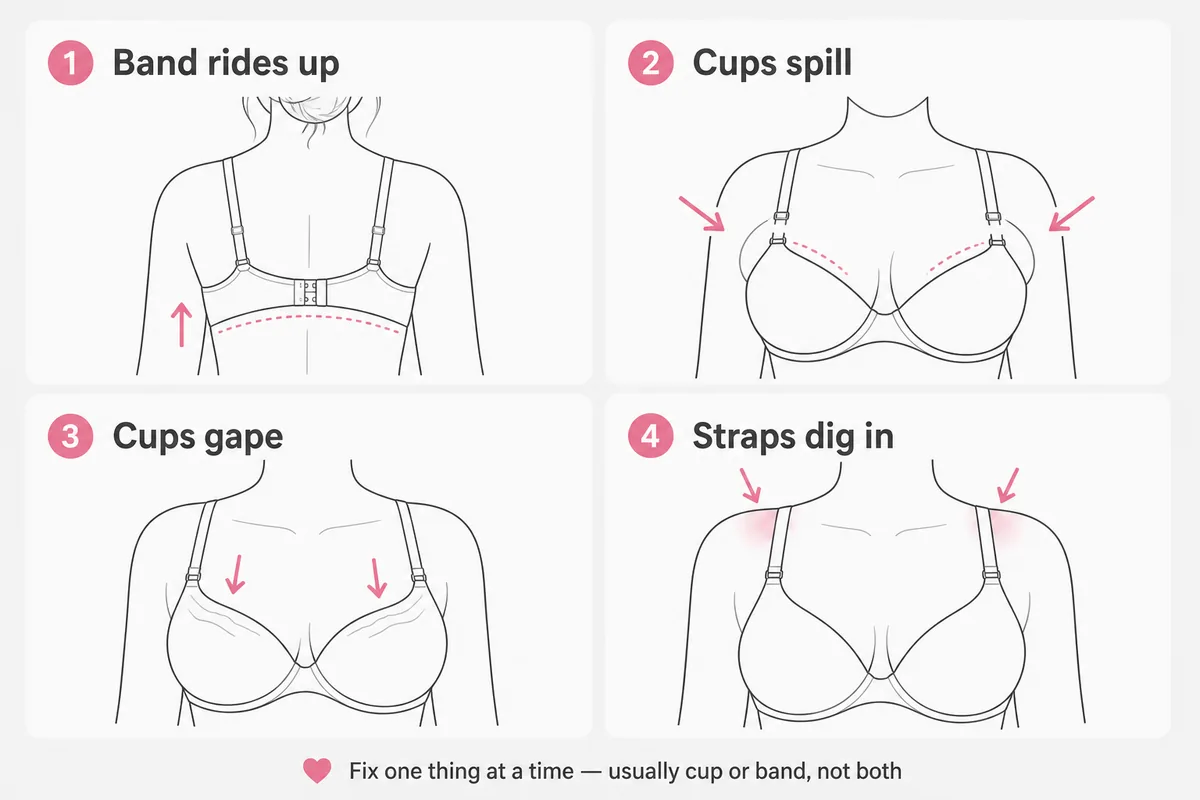
Measure for 32DD
Soft tape, afternoon timing, skin-to-tape under the bust. Full illustrated steps: how to measure bra size.
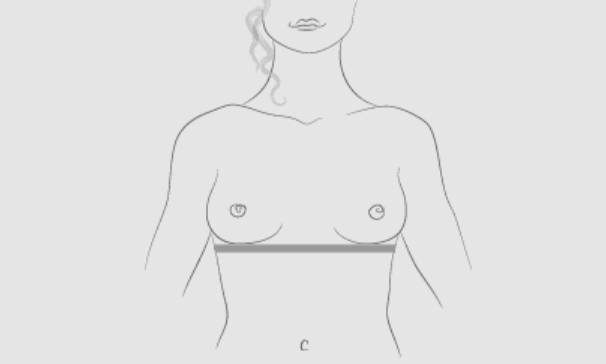
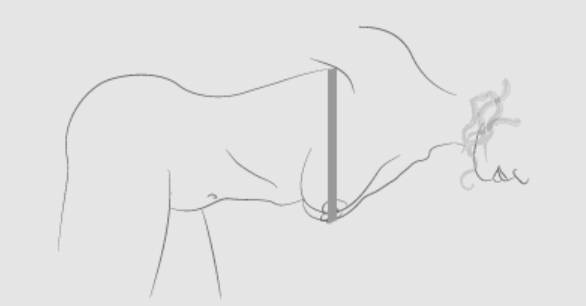
- 1
Firm underbust
Snug tape under bust—32 band candidates measure roughly 28–31 inches. Do not add inches for comfort.
- 2
Standing and leaning bust
For fuller tissue, use leaning bust measure to capture volume 32DD cups must hold.
- 3
Five-inch difference check
Near 5 inches bust-minus-band suggests DD on US charts. Between DD and DDD? Try both on same band.
- 4
Wire trace test
In trial bra, ensure underwire encircles all tissue. Short wires mean try different brand, not automatic 34 band.
32DD support checks
- Band level on loosest hook with minimal strap tension.
- No tissue escape at neckline after scoop.
- Gore touches sternum—floating gore means cups likely too small.
- Wires on ribcage at side, not on breast mound.
- One finger under straps max when band carries weight.
Before judging cups, scoop tissue fully into the cups (scoop & swoop).
Nearby sizes worth comparing
Same letter on a different band is not the same volume. Use these when you are between sizes or a style skips your label.
34DD
Same cup step, wider band
When 32 digs despite good cups.
32B
Much less volume
Only for contrast—usually not a fit swap.
DD vs DDD letters
Naming ladder
When tags say E or double D.
Sister sizes
Equivalents chart
Missing SKUs.
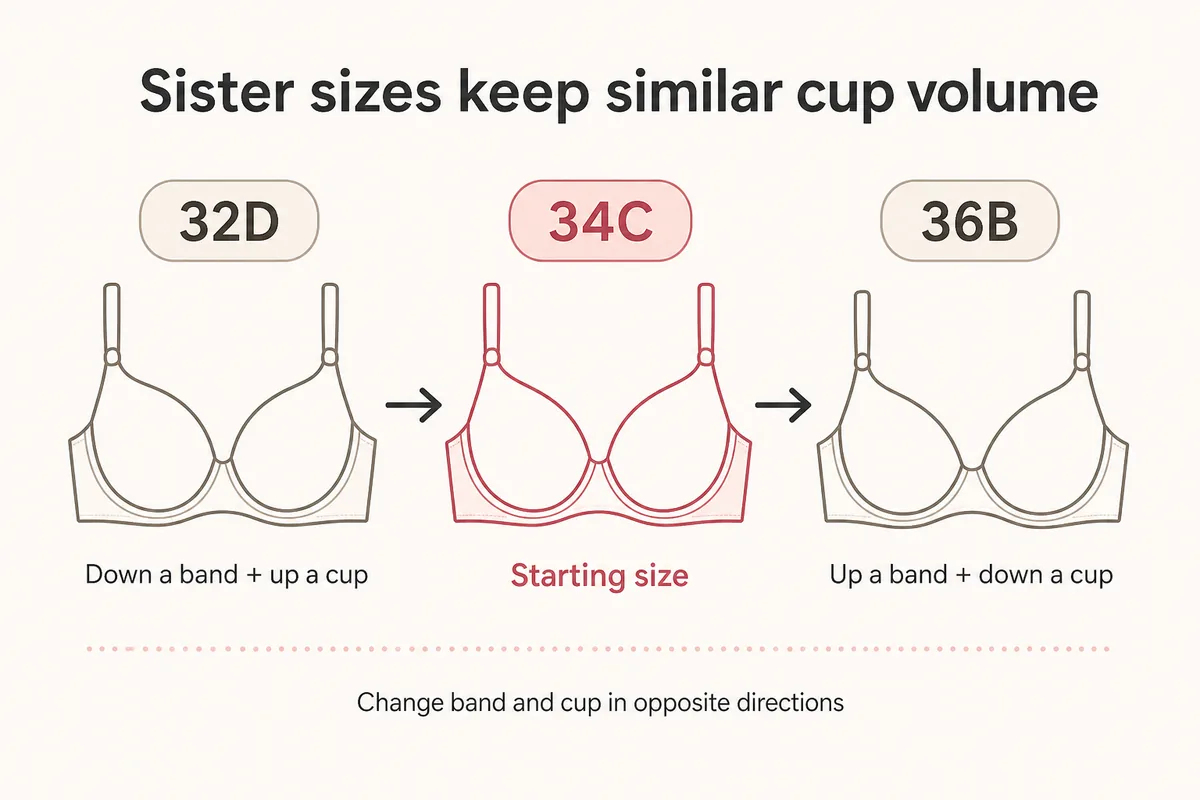
Sister sizes for 32DD
Similar cup volume, different band tension. Full rule and chart: bra sister sizes.
- 30DDD
- 34D
Same size, different shape
The label is volume on a band—not a body type. If the number seems right but the bra still fights you, cup shape is often the missing piece.
Seek depth near the wire; padded push-ups often steal the room you need.
A natural center gap is normal. Side-support panels help center the silhouette without forcing the gore.
Scoop fully into the cups first. Persistent empty space at the top often means cup shape, not a smaller letter.
Tall molded cups often gape at the top. Try a shorter or demi cup before assuming the letter is too big.
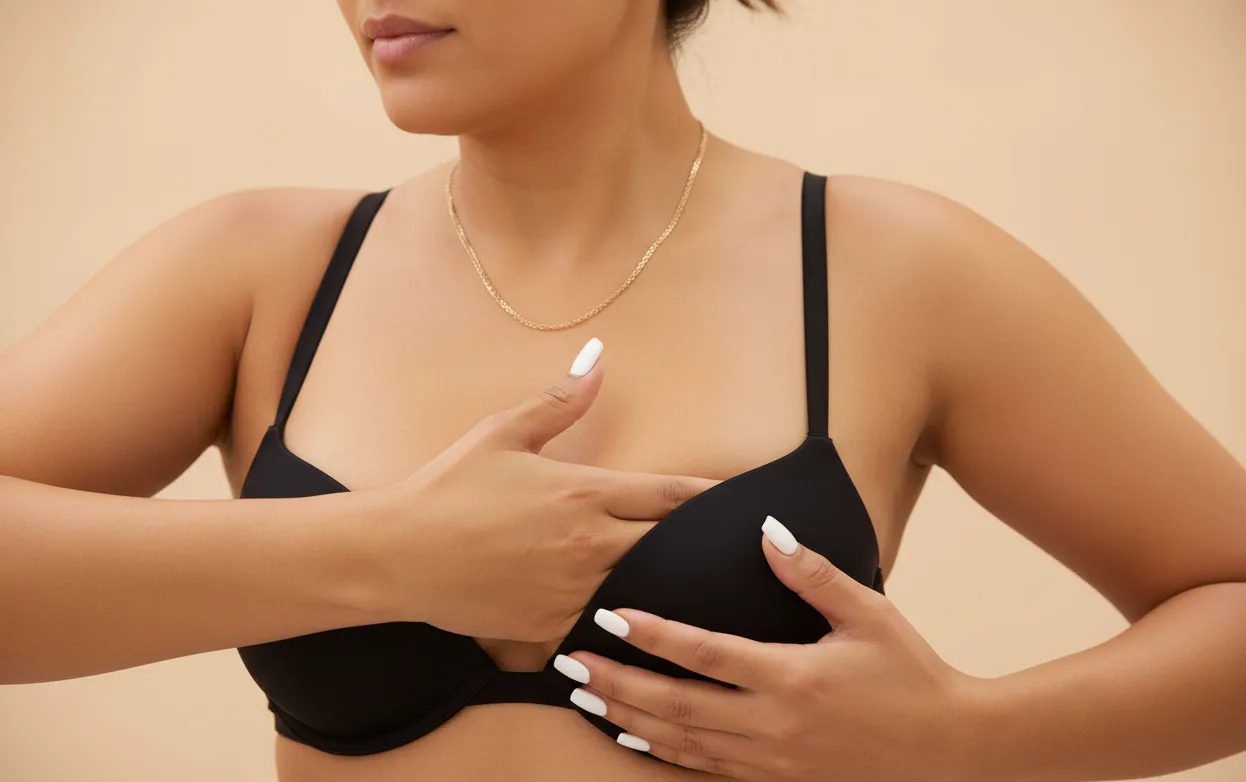
What 32DD is asking for
32DD (often labeled 32E in some markets) is a fuller cup on a narrow band. It is a real measured size—not a contradiction and not rare in extended-cup brands.
You need the security of a 32 and the volume of a DD/E difference—about five inches on many US inch charts. Shallow push-up-only shapes will not replace proper depth.
Sister sizing matters because boutiques may stock 34D more than 32DD. Knowing equivalents keeps you from upsizing the band only to find a cup.
Support comes from a firm wing and a wire (or dense wireless panel) that sits in your fold—not from cranking straps until shoulders ache.
Read DD/DDD letter guides when tags bounce between DD, E, and DDD so you do not accidentally jump two cup steps.
If 32DD overflows after a full scoop but the band is perfect, explore 32DDD/F before leaping to 34 and losing band security.
Who measures 32DD
Snug underbust near 28–31 inches with bust-minus-band around five inches. Narrow ribcage with fuller projection is classic—not rare.
People pushed into 34D or 34DD with riding bands often belong in 32DD or 32DDD once tissue is scooped properly.
Athletes and dancers with strong backs still need correct cup depth—32DD is not defined by lifestyle stereotypes.
Support tips for fuller cups on 32
- Look for sturdy wings and a firm hook-and-eye; fashion-thin bands collapse.
- Wide straps or convertible styles reduce shoulder fatigue.
- Underwire should be long enough to sit behind breast tissue at the side.
- Try brands known for projected cups if molded t-shirt bras leave a flattened look.
- Sister 34D when 32DD band digs; sister 30DDD when band floats—verify brand cup names.
- Sports: encapsulation with firm 32 band beats thin compression crops.
32DD pitfalls
Skip this: Accepting 34D because stores stock it more.
Try this instead: Try 32DD online with free returns—band support matters.
Skip this: Assuming DD means huge bust.
Try this instead: DD is cup step on a band—32DD absolute volume differs from 38DD.
Skip this: Jumping to 34 band when cups overflow.
Try this instead: Try 32DDD/E on same band before band upsize.
When stores skip 32DD
Sisters often include 30DDD and 34D—verify the brand letter system.
If 32DD cups overflow but the band is perfect, explore 32DDD/F before jumping to 34.
Between UK and US brands, check whether E equals DD or next step—order using chart rows, not habit.
Buy 32DD with fewer returns
Specialty and full-bust brands cut 32DD more honestly than mall lines—filter by cup depth reviews.
Keep 34D as backup sister for styles that stop at D on 32 band.
EU 70E orders: screenshot the size chart row that matches your US 32DD before checkout.
How we approach bra sizing
SizeFit tools use bust-to-underbust difference for cup signals, aligned with European clothing size standard EN 13402. Measurement vocabulary follows ISO 8559 work under ISO/TC 133.
Band and cup differences follow classic inch steps used with our calculator—then confirm with a real wear test.
Brands still cut different shapes under the same stamp. Measure, use sister sizes when needed, and keep the bra that stays level through a normal day. Fit guidance—not medical advice.
Frequently asked questions
In many US charts DD and E are used for the same step; UK charts often treat E as the next step after DD. Always check the brand cup ladder.
Common US-style sisters are 34D (looser band, smaller letter) and 30DDD (firmer band, larger letter). Brand ladders vary—confirm on the chart.
Yes—prefer high-support styles with a defined band and separate cups. Thin crop-style compression alone may not be enough for higher impact.
Often worn-out bra, wrong cup depth, or wire too narrow for root width—try different cut before abandoning 32 band.
Less common on mall walls but widely sold online. Sister sizing expands in-store options when 32DD is missing.
Related guides
What a 32 Bra Band Really Means
If you have worn 34 for years, a true 32 can feel surprisingly firm at first—and still be the right anchor once the cups match. Most of the support should come from that snug band, not from digging straps.
Owning a True 34DD Fit
Plenty of people discover 34DD only after leaving a too-small 34C/D or a stretched 36. The win is keeping a common band while admitting the cup volume you actually need.
DD vs DDD: Double D, Triple D & Letter Chart
DD and DDD are steps on a cup ladder, not a separate sizing universe. Confusion usually comes from tags that print E/F for the same steps—or from UK charts that place E differently.
Sister Sizes Keep Cup Volume, Change the Band
When cups already sit well but the band digs or rides up, sister sizes let you change tension without throwing away the volume that worked. They are a fitting tool—not a reason to skip measuring.