
Belt Size Chart
US rule of thumb: belt label ≈ waist +2 in (32 in waist → try belt 34). Measure where the belt will sit—do not assume pants tag equals belt size.
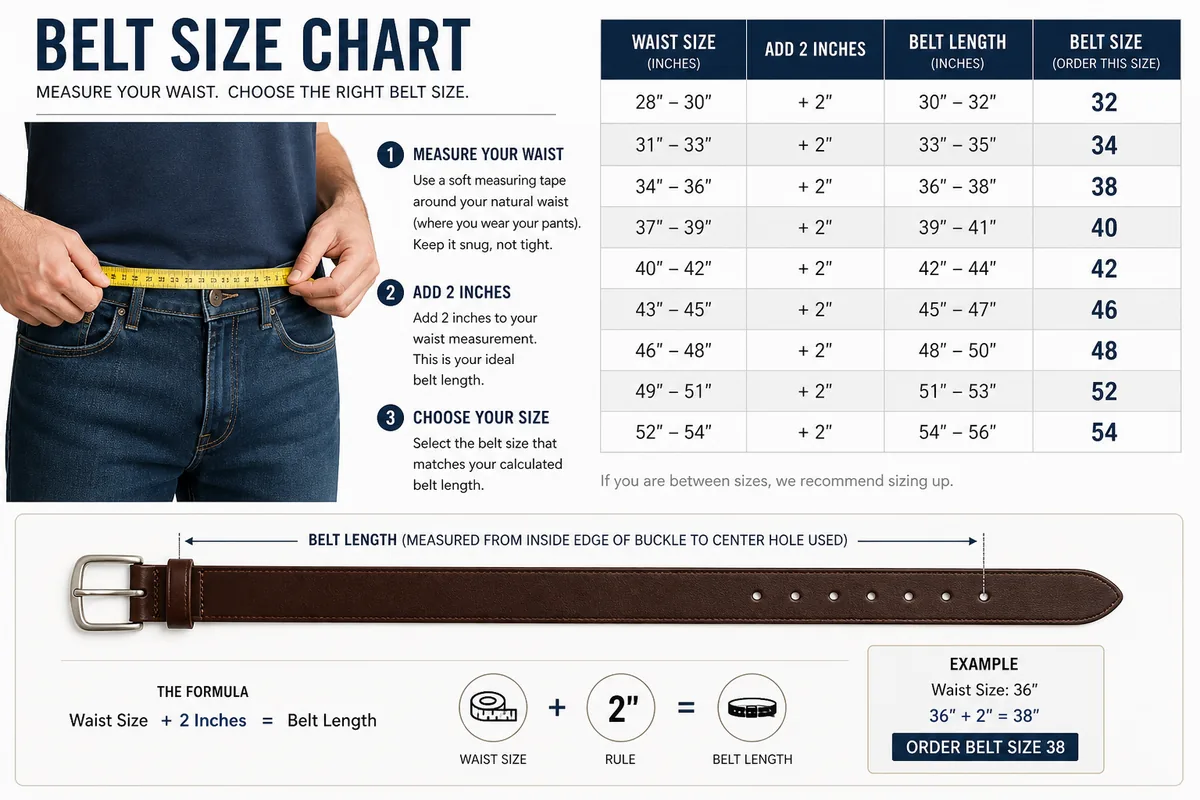
+2 inch rule disclaimer
The waist +2 rule is a US casual-belt convention. EU belts often list total length in cm. Always check whether the brand sizes to middle-hole placement or total strap length.
Waist → belt label (US +2 rule)
| Waist (in) | Try belt size | EU strap (cm / in) |
|---|---|---|
| 28 | 30 | 75–80 cm (~30–31 in) |
| 30 | 32 | 80–85 cm (~31–33 in) |
| 32 | 34 | 85–90 cm (~33–35 in) |
| 34 | 36 | 90–95 cm (~35–37 in) |
| 36 | 38 | 95–100 cm (~37–39 in) |
| 38 | 40 | 100–105 cm (~39–41 in) |
Belt sizing: waist vs belt length
Men's belt labels often show waist size (32, 34) meaning the middle hole fits that waist. Belt total length is ~6–8 inches more than waist number. Women's belts may use S/M/L or cm.
Measure where the belt will sit—jeans waist ≠ dress waist for low vs mid rise.
Men's belt waist to length
| Belt label | Fits waist in | Belt total length in |
|---|---|---|
| 30 | 30–31 | 36 |
| 32 | 32–33 | 38 |
| 34 | 34–35 | 40 |
| 36 | 36–37 | 42 |
| 38 | 38–39 | 44 |
Choose belt size
- 1
Measure worn waist
Through belt loops if for jeans.
- 2
Pick belt = waist size
Men's standard: label matches waist.
- 3
Check holes
Middle hole at desired fit.
- 4
Women's belts
Use hip/waist cm on product chart.
Belt tips
- Thick winter jeans may need +1 belt size vs summer.
- Reversible belts same sizing as leather single-side.
- Hole punch last resort—buy correct length first.
- Web belts with infinite buckle—cut to length instructions.
Belt mistakes
Avoid: Belt length = waist exactly end-to-end
Instead: Label is worn waist, not total strap.
Avoid: Pant size = belt size always
Instead: Vanity pant + layering changes belt need.
Avoid: Women's S without measuring
Instead: Check cm range 26–28" waist etc.
Belt anatomy
Belt width (1.25 in vs 1.5 in) changes which pant loops fit—not the waist number.
Automatic ratchet belts cut to length—follow trim guide; do not use pant size alone.
Women's fashion belts may size S/M/L by hip, not waist, when worn low on hips.
Return or exchange workflow
- 1
Keep packaging
Boxes and hang tags speed refunds when size is wrong.
- 2
Try indoors only
Scuffed soles or worn labels may void returns.
- 3
Document fit issue
Photo of pinch point or heel gap helps support.
- 4
Reorder fast movers
Half sizes and popular EU widths sell out during sales.
More belt size chart questions
- Should I size up when between chart rows?
- Non-stretch and leather usually need the larger row; stretch fabrics may take the smaller.
- Do regional sites use different charts?
- Yes—US, EU, and Asia storefronts sometimes grade differently for the same SKU.
- How often to remeasure?
- Feet: twice a year or after weight change; kids: every 2–3 months; bras: after body changes.
- Are marketplace sellers reliable for size?
- Authorized retailers match brand charts; third-party listings may be old season lasts.
- Where to start with feet?
- See how to measure shoe size before converting sizes.
Real-world notes on belt size chart
Charts for belt size chart summarize typical grading—they are not a guarantee for every season or factory run. When a brand refreshes a last or fit block, reviews often mention it before charts update.
Marketplace listings may ship mixed inventory. Compare the size stamped inside the item on delivery with the chart row you used at checkout.
If you are gifting, ask for body or foot measurements in cm instead of guessing their usual tag size. Gift returns are harder when wear signs appear.
Sales associates can measure you in store; take a photo of the store chart if you later order online from the same brand.
Between online orders, remeasure if your weight changed, you had a foot injury, or you switched sock or insole thickness for running.
Teaching kids their cm size helps them shop later—write foot length inside closet door as a reference.
Document the date you measured—repeat after pregnancy, injury, or major weight change so old numbers do not linger in notes apps.
Measurement hygiene
- Stand weight evenly on both feet when tracing outlines.
- Measure twice on different days if you are between rows.
- For clothing, wear the undergarments you will use with the piece.
- For shoes, match sock thickness to intended use.
- Convert using cm first, then read US/UK/EU from the row—never reverse the order.
- Keep a saved note on your phone with your foot cm and bust/waist/hip cm.
- Update kids' sizes every growth spurt—do not buy multiple seasons ahead.
- Check whether reviews mention 'runs small' for the exact model you chose.
- Prefer free-return windows when trying a new brand last.
- Wide feet: try width SKUs before adding length—see 2E vs 4E shoe width.
Common belt size chart errors
Avoid: Using an old size tag from a different brand
Instead: Measure today and match the chart row for this category.
Avoid: Rounding down cm to stay in a smaller letter size
Instead: Round to the row that fits your longer foot or largest body measure.
Avoid: Ignoring half sizes or wide widths
Instead: Half steps and 2E/4E widths fix fit better than guessing.
Avoid: Assuming sales charts match outlet or marketplace stock
Instead: Verify inside label on delivery against the chart you saved.
Extra belt size chart answers
- Online vs in-store size the same?
- Usually yes for current season full-price items; outlets and older stock may differ slightly.
- Do I need to convert if the site shows multi-scale?
- Pick the column you shop in, but confirm your cm or inch measure lands on that row.
- Should athletes size up?
- Running and court sports often need thumb-width toe room—see running shoe size fit.
- Are charts unisex?
- Only when labeled unisex—otherwise use men's and women's tables separately.
- What if half my foot measures between rows?
- Use the longer foot and the larger measure among bust, waist, and hip for clothing.
Belt size FAQ
- Pant 32 belt size?
- Usually belt 32 for men's dress/jeans belt.
- Between 33 and 34?
- Buy 34; use inner holes.
- Women's belt M?
- Often 32–34" waist range—read tag.
- Leather stretch?
- Slight—do not oversize much.
- Measure old belt?
- Waist size ≈ length from buckle fold to most-used hole.
FAQ
- What belt size for a 32 inch waist?
- Many US casual belts use waist +2 inches—32 in waist often takes a belt labeled 34. Measure your actual waist or hips where the belt will sit; vanity-sized pants may not match your tape.
- Why do belts add 2 inches to waist size?
- The +2 rule accounts for belt overlap through the buckle and middle hole placement. It is a rough US convention, not a universal standard—designer belts may size to exact cm length.
- Is belt size the same as pants size?
- Not always. Jeans W32 may measure 34 in on the tape (vanity sizing). Measure the body zone where the belt rides—often between natural waist and hips for jeans belts.
- How do I measure for a dress belt?
- Wear dress trousers at your usual height. Measure over the waistband where the belt will loop. Pick the belt length so the pin lands near the middle hole—often cm length = pant waist + 5–10 cm on EU charts.