
What Does D Mean? D vs 2E Shoe Width
D is men's standard (medium) width. 2E (EE) is wider—about 3/8 inch wider than D at the same size. Women's standard is usually B; women's D means wide.
| Label | Meaning (men's US) | Vs standard D |
|---|---|---|
| D / M / R | Standard (medium) | Baseline |
| E | Wide | ~3/16" wider |
| 2E / EE / W | Wide (common wide label) | ~3/8" wider than D |
| 4E / EEEE / XW | Extra wide | Wider than 2E |
D vs 2E at a glance (men's US)
- Where does D fall? D is men's standard / medium—the middle of the width range, not narrow and not wide.
- 2E / EE = wide — yes, 2E is wider than D (~3/8")
- 4E / EEEE = extra wide — wider than 2E
Need full men's / women's letter tables, 2E / 4E, or UK width? See the shoe width size chart.
Quick Width Reference
Narrow
B (Men)
/ AA (Women)
For narrow feet
Standard
D (Men)
/ B (Women)
Most common width
Wide
E/EE (Men)
/ D (Women)
For wide feet
Extra Wide
EEE/EEEE (Men)
/ EE (Women)
For very wide feet
What Does D Mean in Shoe Size?
The letter D in shoe sizing represents the standard (medium) width for men's shoes in the US sizing system. However, there's an important distinction between men's and women's shoes:
- Men's shoes: D = Standard width (most common)
- Women's shoes: D = Wide width (their standard is B)
When you see a shoe size like "US 9D," it means size 9 with D width. If no width is specified (just "US 9"), it typically defaults to the standard width for that gender.
Searching D vs 2E? For men, 2E is wider than D (about 3/8 inch). See the D vs 2E summary above or the men's width letter chart.
International Shoe Width Systems Explained
Width letters (B, D, 2E, 4E) are not universal. Use the charts below to map US, UK, and EU width labels before you buy abroad.
| Width Description | N-M-R-W System | US Men's | US Women's | UK System | German System | Width Increment |
|---|---|---|---|---|---|---|
| Extra Extra Narrow | - | AAAA (4A) | AAAA (4A) | - | - | - |
| Extra Narrow | N | AAA (3A) | AAA (3A) | C | A | - |
| Narrow | N | AA (2A) | AA (2A) | D | B | - |
| Narrow | N | A | A | E | C | - |
| Standard/Medium | M | B | B | F | D | Standard |
| Standard/Medium | R | D | D | G | E | Standard |
| Wide | W | E | E | H | F | +3-6mm |
| Wide | W | EE (2E) | EE (2E) | J | G | +6-9mm |
| Extra Wide | XW | EEE (3E) | EEE (3E) | K | H | +9-12mm |
| Extra Extra Wide | XXW | EEEE (4E) | EEEE (4E) | L | I | +12-15mm |
| Ultra Wide | - | EEEEE (5E) | - | - | - | +15mm+ |
⚠️ Important Width System Notes
US System Gender Differences:
- Men's Standard: D width (equivalent to M/R in universal system)
- Women's Standard: B width (equivalent to M/R in universal system)
- Key Point: Same letter means different widths for men vs women
UK System:
- Standard Width: F (for both men and women)
- Women's B in UK: Does not exist - UK uses C-L system for all genders
- Width Range: C (narrowest) to L (widest)
Data Sources: Based on ISO 19407:2015 international standard and Beck's Shoes width guide
N-M-R-W System (Universal)
- N (Narrow): For narrow feet, typically 2-3mm narrower than standard
- M (Medium): Standard width for most people
- R (Regular): Alternative term for medium width
- W (Wide): For wide feet, typically 3-6mm wider than standard
- XW (Extra Wide): For very wide feet, 6-9mm wider
- XXW (Extra Extra Wide): For extremely wide feet, 9-12mm wider
North American System
- Men's Standard: D width (equivalent to M/R)
- Women's Standard: B width (equivalent to M/R)
- Width Increments: Each letter represents ~3/16 inch (4.8mm) difference
- Multiple E's: 2E, 3E, 4E, 5E indicate progressively wider widths
- Multiple A's: 2A, 3A, 4A indicate progressively narrower widths
Country-Specific Width Systems
UK Width System
The UK system uses letters from C to L, with F being the standard width for most shoes.
- C: Extra narrow
- D: Narrow
- E: Narrow-medium
- F: Standard/Medium (most common)
- G: Wide
- H: Extra wide
- J: Very wide
- K: Extra extra wide
- L: Ultra wide
German Width System
The German system uses letters from A to I, with D being the standard width.
- A: Extra narrow
- B: Narrow
- C: Narrow-medium
- D: Standard/Medium (most common)
- E: Wide
- F: Extra wide
- G: Very wide
- H: Extra extra wide
- I: Ultra wide
Width Increment Standards
Understanding width increments helps you choose the right size when converting between systems:
- North American: Each width increment = 3/16 inch (4.8mm)
- UK System: Each width increment = 1/4 inch (6.4mm)
- German System: Each width increment = 5mm
- International: Width increases proportionally with shoe length
Shoe Width Measurements by Size
Men's Shoe Width (inches)
| US Size | B (Narrow) | D (Standard) | E (Wide) | EE (2E) |
|---|---|---|---|---|
| 8 | 3.6 | 3.8 | 4.0 | 4.2 |
| 9 | 3.8 | 3.9 | 4.1 | 4.3 |
| 10 | 3.9 | 4.0 | 4.2 | 4.4 |
| 11 | 4.1 | 4.3 | 4.5 | 4.7 |
| 12 | 4.3 | 4.4 | 4.6 | 4.8 |
Women's Shoe Width (inches)
| US Size | AA (Narrow) | B (Standard) | D (Wide) | EE (2E) |
|---|---|---|---|---|
| 6 | 2.99 | 3.25 | 3.44 | 3.75 |
| 7 | 3.11 | 3.37 | 3.56 | 3.87 |
| 8 | 3.23 | 3.49 | 3.68 | 3.99 |
| 9 | 3.35 | 3.61 | 3.80 | 4.11 |
| 10 | 3.47 | 3.73 | 3.92 | 4.23 |
How to Measure Shoe Width Accurately
Width measurement matters as much as length for comfort. A length that matches but a too-narrow last still hurts.
In-Store Measurement (Recommended)
- Find a shoe store with a Brannock device (most major retailers have them)
- Remove your shoes and socks for accurate measurement
- Stand on the device with your full weight distributed evenly
- Position your heel against the back of the device
- Slide the width bar to touch the widest part of your foot
- Read the width measurement from the device's scale
- Measure both feet and use the larger measurement
- Note the width letter (B, D, E, etc.) for future reference
Home Measurement Method
- Gather materials: Paper, pencil, ruler, and flexible measuring tape
- Place paper on hard surface (not carpet)
- Stand on paper with full weight and feet shoulder-width apart
- Trace around your foot keeping pencil perpendicular to paper
- Find the widest point (usually at the ball of the foot)
- Measure the width in millimeters or inches
- Use flexible tape to measure foot circumference at widest point
- Compare measurements to width charts for your shoe size
Width Measurement Reference Chart
| US Men's Size | B Width (mm) | D Width (mm) | E Width (mm) | EE Width (mm) |
|---|---|---|---|---|
| 8 | 91 | 97 | 102 | 107 |
| 9 | 94 | 99 | 104 | 109 |
| 10 | 97 | 102 | 107 | 112 |
| 11 | 100 | 105 | 110 | 115 |
| 12 | 103 | 108 | 113 | 118 |
Signs You Need a Different Width
- Too Narrow: Pinching, blisters on sides, toes feel cramped
- Too Wide: Foot slides around, heel slippage, lack of support
- Width Issues: Shoes feel tight in width but loose in length
- Comfort Problems: Pain after short periods of wear
- Fit Inconsistency: Same size fits differently across brands
Width Adjustment Tips
- Try Different Widths: Don't assume you're always the same width
- Consider Shoe Type: Athletic shoes often need different width than dress shoes
- Account for Socks: Measure with the socks you'll wear
- Time of Day: Feet swell throughout the day, measure in afternoon
- Brand Variations: Some brands run wider or narrower than others
📏 Measurement Guide Images
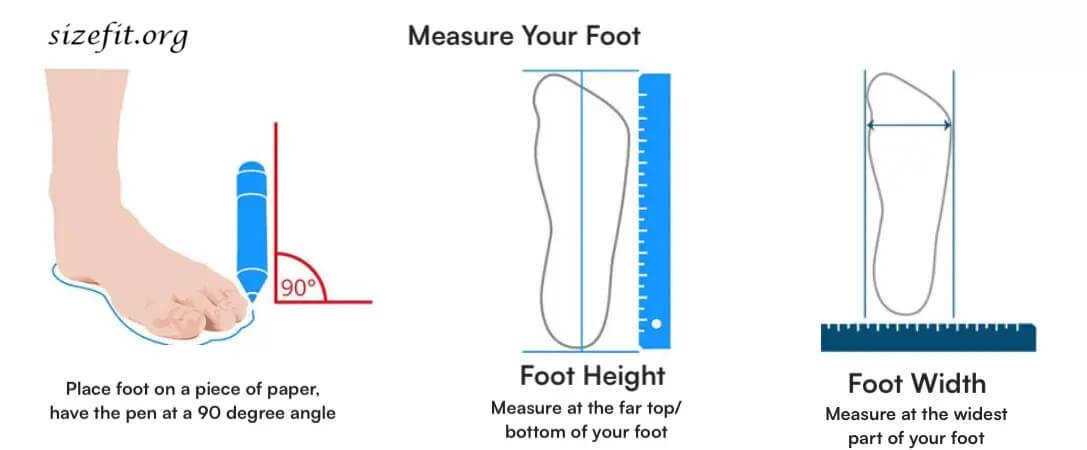
Visual instructions for measuring foot width accurately at home
Wide Width Shoes Guide
Wide Width Shoes for Women
- Dress shoes: Look for D or EE width
- Casual shoes: Many brands offer wide options
- Athletic shoes: Running and walking shoes often come in wide
- Heels: Some brands specialize in wide width heels
- Flats: Ballet flats and loafers in wide widths
Wide Width Shoes for Men
- Dress shoes: E or EE width for formal wear
- Casual shoes: Many sneakers available in wide
- Athletic shoes: Running, basketball, and training shoes
- Work boots: Safety and work footwear in wide
- Sandals: Summer footwear with wide options
Brands Known for Wide Width Options
Athletic Brands
- New Balance
- Brooks
- ASICS
- Saucony
Casual Brands
- Clarks
- Rockport
- Naturalizer
- Easy Spirit
Specialty Brands
- Propet
- Orthofeet
- Drew Shoes
- Hush Puppies
Width Conversion Tools & Calculators
Use our interactive tool to convert between different width systems and calculate your width based on foot measurements.
✨ Live Tool: This converter uses authoritative data from ASICS width standards, New Balance sizing guides, and ISO 19407:2015 international standards. Try it below!
Convert between international width systems or calculate your width based on foot measurements
🔵From (Source)
🟢To (Target)
Please check your input
No shoe width size “D” in our chart. Double-check the number or letter, or pick a nearby size from the table. Try D, B, 2E.
Quick Width Conversion Reference
Standard Width Equivalents
- US Men's D = US Women's B = UK F = German D = Universal M/R
- US Men's E = US Women's D = UK H = German F = Universal W
- US Men's EE = US Women's EE = UK J = German G = Universal W
Width Increments
- US System: 3/16 inch (4.8mm) per increment
- UK System: 1/4 inch (6.4mm) per increment
- German System: 5mm per increment
Frequently Asked Questions
What is standard vs 2E shoe width?
For men's US shoes, standard width is D (medium). 2E (EE) is wide—about 3/8 inch wider than D at the same length. If a listing says only the size with no width letter, men's usually means D.
What is W vs D in shoe width?
W (wide) in the N-M-R-W system maps to E or 2E in men's US letters—wider than D (standard/medium). On women's shoes, D often means wide while B is standard, so women's D is not the same as men's D.
Is 14 D vs E width different?
Yes. On a size 14, D is men's standard width and E is one step wider (~3/16 inch more than D). E is not as wide as 2E (EE), which is two steps above D.
What does D mean in shoe size?
D is the standard (medium) width for men's shoes in the US sizing system. For women's shoes, the standard width is B. D width is neither narrow nor wide - it's the average width that fits most people.
Where does D width fall in the range of mens shoe widths?
For men, D falls in the middle of the width range: it is the standard (medium) width. Narrower letters are toward A/B/C; wider letters are E, 2E (EE), 3E, and 4E (EEEE). If a men's shoe lists no width, it usually means D.
Is 2E wider than D?
Yes. 2E (also written EE) is wider than D. For men, D is standard and 2E is a common wide width—about 3/8 inch (two width steps of roughly 3/16 inch each) wider than D at the same length.
What is 2E and D width?
D is men's standard (medium) width. 2E / EE is wide—two steps wider than D. On women's shoes, D usually means wide (women's standard is B), so women's D is not the same as men's D.
How much wider is 2E than D?
2E (EE) is approximately 3/8 inch wider than D at the same shoe size. Each US width step (D→E, E→EE) is about 3/16 inch; brands can vary slightly.
How do I measure my shoe width?
To measure shoe width, place your foot on a piece of paper, trace around it, then measure the widest part of your foot. Use a Brannock device at a shoe store for the most accurate measurement.
What is the difference between D and E width?
D is standard width, while E is wide width. E width is approximately 3/16 inch wider than D width. For men, D is standard; for women, D is considered wide (their standard is B).
What does shoe width B mean?
B width is narrow for men's shoes but standard (medium) width for women's shoes. It's the most common width for women's footwear in the US sizing system.
How much wider is EE than D?
EE (2E) width is approximately 3/8 inch wider than D width. Each width increment (D to E, E to EE) adds about 3/16 inch to the width measurement.
What's the difference between UK and US width systems?
UK system uses letters C-L with F as standard, while US uses A-EEEE with D as men's standard and B as women's standard. UK increments are larger (6.4mm vs 4.8mm).
How do I convert between N-M-R-W and letter systems?
N-M-R-W is universal: N=Narrow, M/R=Medium/Regular, W=Wide, XW=Extra Wide. M/R corresponds to D (men) or B (women) in US system, F in UK system, and D in German system.
Why do width measurements change with shoe size?
Width increases proportionally with length because larger feet are generally wider. A size 12 D is wider than a size 8 D, but both represent the same relative width (standard).
Which brands offer the widest range of widths?
New Balance, Brooks, and ASICS offer widths from 2A to 6E. For dress shoes, Allen Edmonds and Alden offer extensive width options. Many athletic brands now offer at least D and E widths.
Need More Size Help?
Use our professional size conversion tools for accurate measurements and conversions.