New Baby Size Checklist
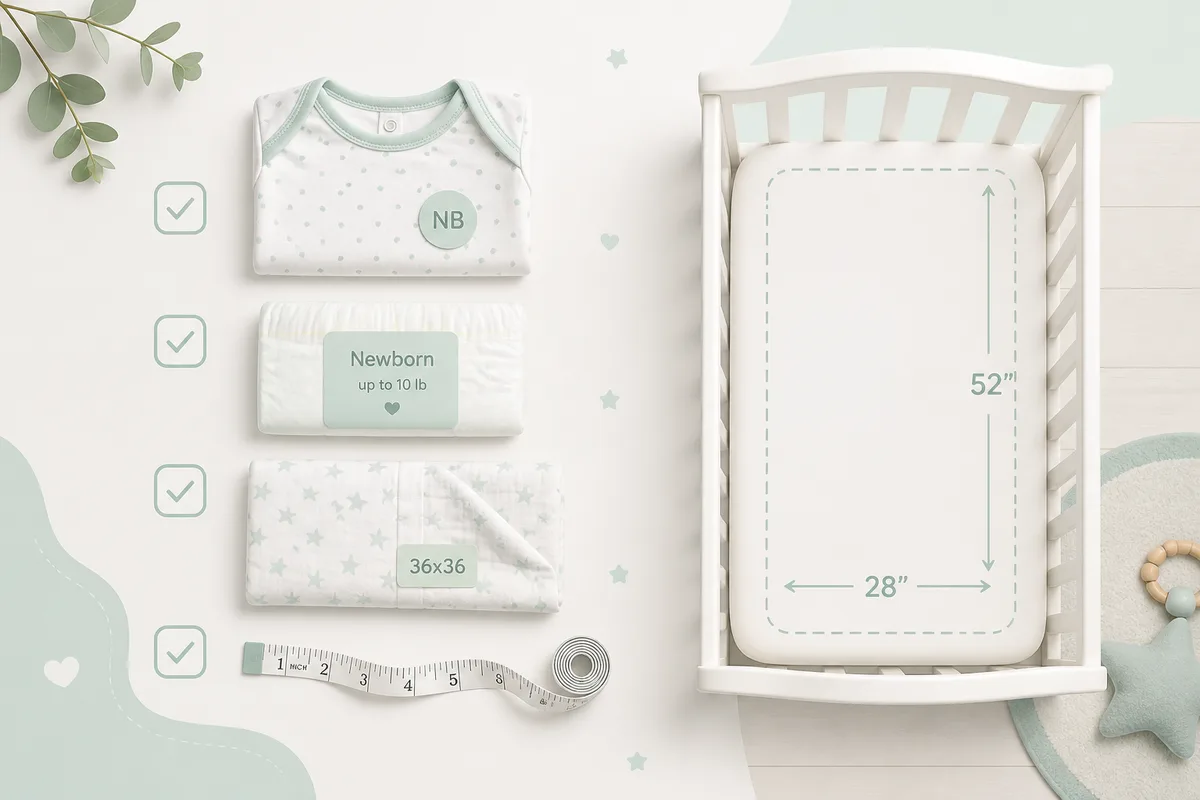
Newborn diapers: up to ~10 lb · Size 1: 8–14 lb · 0–3m clothes: ~62 cm / 5 kg · Receiving blanket: often 30×30 or 30×40 in · Crib mattress: ~27×52 in (often labeled 28×52). Enter weight below to pick a diaper size, then use the tables for clothes, blankets, and the crib.
Last updated: September 2026 · Not medical advice—follow your pediatrician and product labels.
Diaper size by baby weight
Enter weight to see matching sizes. Newborn and Size 1 overlap near 8–10 lb—pick the label that seals at the legs without red marks.
Enter current weight for a rough match to common US diaper bands. Results show the typical weight range for each size—overlapping sizes are normal; fit matters more than the label.
Diaper weight chart (Preemie–Size 4)
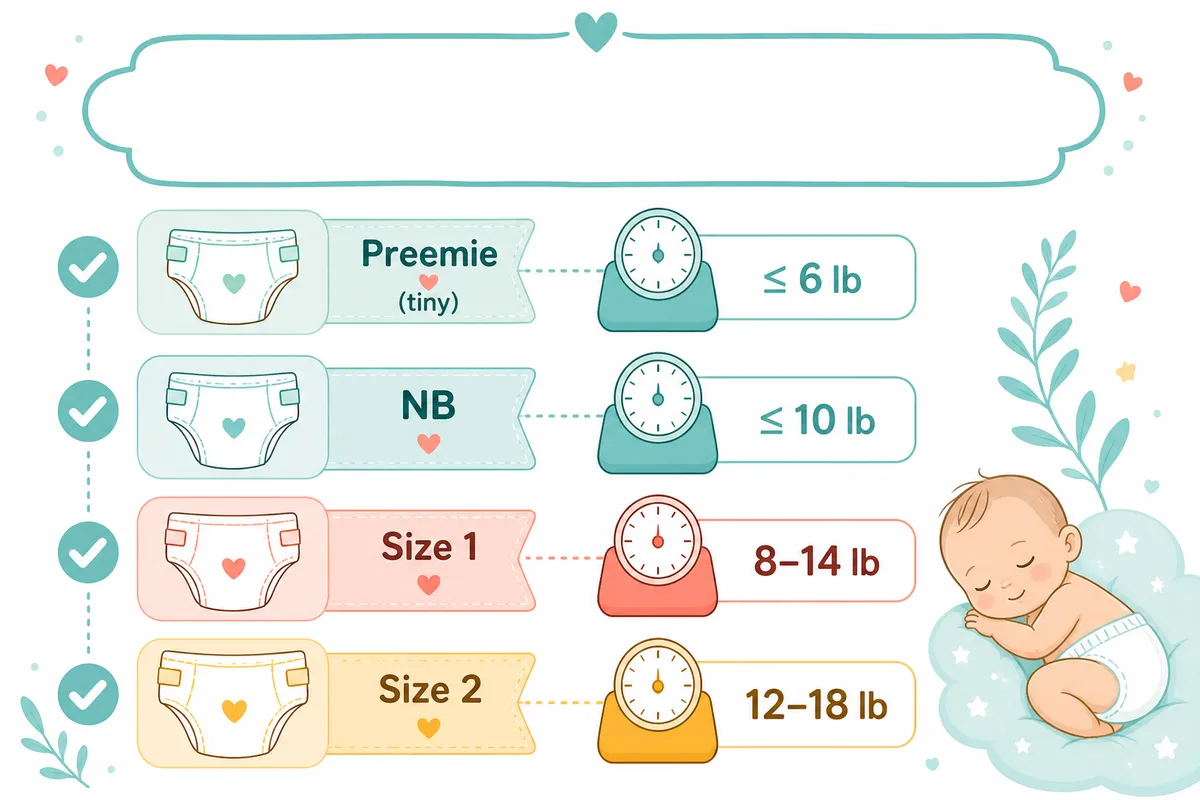
Typical US retail diaper packaging weight bands. Pampers and Huggies overlap differently—use each brand table below. Always follow the current package and your pediatrician's guidance.
| Size | Weight (lb) | Weight (kg) | Notes |
|---|---|---|---|
| Preemie | Up to 6 lb | Up to 2.7 kg | Common on Huggies and Pampers preemie lines; hospital guidance may override retail sizing. |
| Newborn (N) | Up to 10 lb | Up to 4.5 kg | Common starting point for many newborns; overlap with Size 1 is normal near 8–10 lb. |
| Size 1 | 8–14 lb | 4–6 kg | Both major US brands list this band on Size 1 packs. |
| Size 2 | 12–18 lb (Huggies) · 10–22 lb (Pampers) | 5–8 kg · 4.5–10 kg | Pampers starts Size 2 lower; check your brand's box when between 10–12 lb. |
| Size 3 | 16–28 lb (Huggies) · 13–26 lb (Pampers) | 7–13 kg · 6–12 kg | One of the longest-used daytime sizes; bands overlap with Size 2 and 4. |
| Size 4 | 22–37 lb (Huggies) · 15–34 lb (Pampers) | 10–17 kg · 7–15 kg | Crawler/toddler range; Pampers lists a wider lower bound than Huggies. |
When to size up
- Leaks after a proper waist and leg fit
- Fasteners barely meet or the front looks stretched
- Deep red lines from elastic
Brand tables: Pampers by weight · Huggies by weight · full diaper guide (Size 5–8 + swim).
Baby clothes sizes (NB & 0–12 months)
Newborn (NB) is usually shorter than 0–3 months. Buy a few NB onesies for smaller babies, then lean on 0–3 after you know length and weight. Month labels are rough; height and weight are more reliable.
Newborn (NB)
Smaller cut · often under ~7–8 lb
Keep the stack light. Many babies outgrow NB in days or skip it.
0–3 months
~62 cm height · ~5 kg · chest ~43 cm
Main early wardrobe size on our kids chart. Brands still differ—check the hangtag.
Clothes by age label (height & weight)
| US label | UK | EU | Height (cm) | Weight (kg) | Chest (cm) |
|---|---|---|---|---|---|
| 0-3m | 0-3m | 62 | 62 | 5 | 43 |
| 3-6m | 3-6m | 68 | 68 | 8 | 46 |
| 6-9m | 6-9m | 74 | 74 | 9 | 47 |
| 9-12m | 9-12m | 80 | 80 | 10 | 48 |
Convert by age or height: kids clothing size converter. Full kids / youth table: kids size chart.
Baby blanket & crib mattress sizes
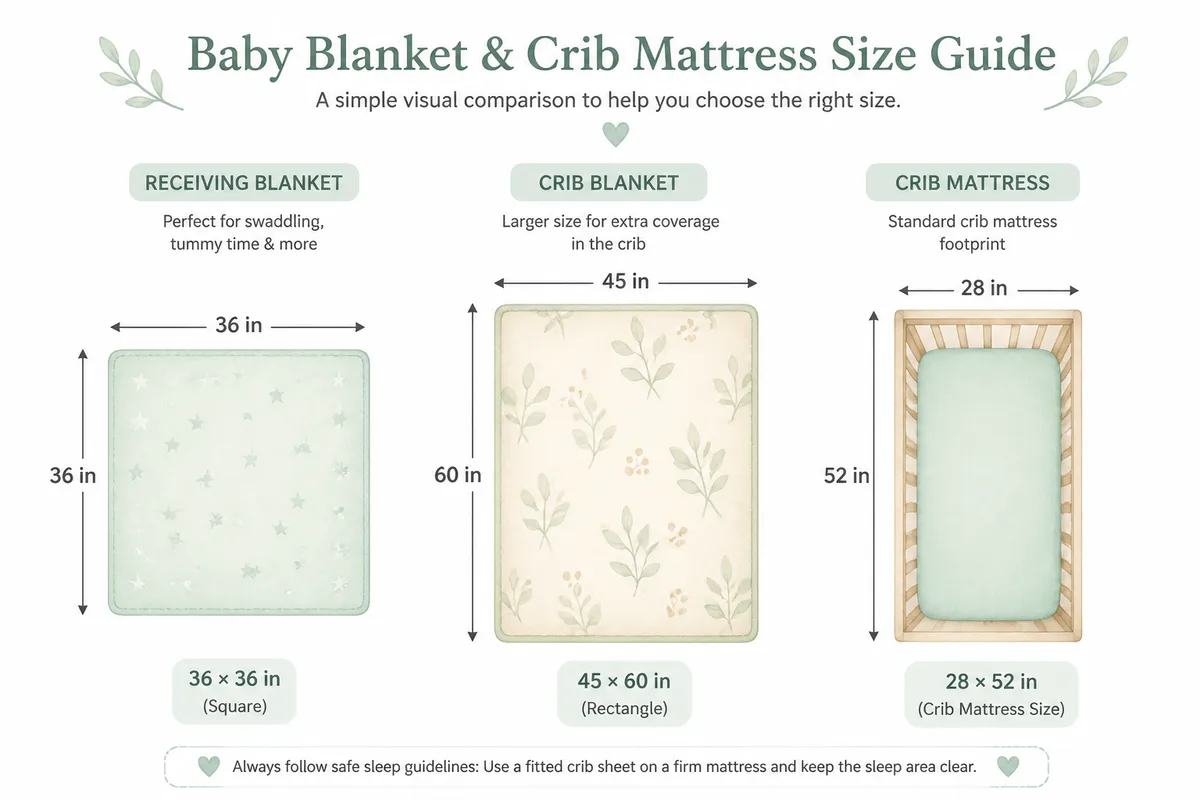
Pick the blanket by use (receiving vs swaddle vs crib). Confirm the mattress matches the crib maker’s size—standard and mini are not interchangeable.
Blanket sizes by use
| Type | Inches | cm | Typical use |
|---|---|---|---|
| Receiving | 30×30 or 30×40 | 76×76 or 76×102 | Newborn light wrap, burp cloth, changing pad |
| Swaddle | About 40×40 to 48×48 | 102×102 to 122×122 | Secure wrap; brand sizes vary |
| Crib (older babies) | About 36×52 to 40×60 | 91×132 to 102×152 | Common retail sizes after safe-sleep guidance allows a crib blanket |
Crib mattress sizes
| Mattress | Width × length (in) | cm |
|---|---|---|
| Standard Crib | 27.25 × 51.625 | 69.2 × 131.1 |
| Mini Crib | 24 × 38 | 61 × 96.5 |
Under US CPSC rules, a full-size crib mattress must be at least 27¼ × 51⅝ in. Retail often rounds labeling to 28 × 52 in. More bedding sizes: baby blanket guide · full mattress chart · sheet sizes.
What to buy before birth
| Item | Starter amount | Why |
|---|---|---|
| Newborn diapers | 1 small pack | Enough if birth weight is under ~8–10 lb; avoid overstock |
| Size 1 diapers | 1–2 packs after weight known | Many babies move here quickly |
| NB clothes | 4–6 onesies / sleepers | Light stack; larger babies may skip NB |
| 0–3 months clothes | 8–12 everyday pieces | Main early wardrobe size |
| Receiving blankets | 3–6 (often ~30×30 in) | Wrap, burp cloth, stroller cover |
| Crib mattress | 1 sized to the crib | Standard ≈ 27×52 in; mini is smaller |
After birth: remeasure weight for diapers, keep receipts when possible, and wait on hard-soled shoes until walking outdoors.
Your prep checklist
0 of 8 done · loading saved list…
Check off size-related prep. Add your own lines if needed. Saved in this browser only.
First shoe sizes (when you need them)
Soft booties do not need a chart size. For outdoor shoes, measure heel-to-toe in cm and match US C sizes. Boys and girls use the same numbers.
Rough age cue only: about 0–3 months often falls near 7–10 cm foot length before hard shoes matter—always measure both feet.
| US (C) | Foot length (cm) | Note |
|---|---|---|
| 1C | ~8.9 | Early soft shoes / booties transition |
| 2C | ~9.5 | Common early walker start |
| 3C | ~10.5 | Measure both feet |
| 4C | ~11.6 | Often near late infant / early toddler |
| 5C | ~12.7 | Confirm with cm, not age |
Full baby shoe chart (1C–5C) →Kids shoe converter →Foot length to shoe size →
FAQ
What size diapers for a newborn?
Newborn diapers are commonly listed up to about 10 lb (4.5 kg). Larger newborns often start in Size 1 (about 8–14 lb). Check leg seal and the pack chart—not age alone.
What is the newborn diaper weight range?
The newborn diaper weight range is typically up to about 10 lb (about 4.5 kg). It overlaps with Size 1 near 8–10 lb, so fit on your baby decides which label to use.
What weight is Size 1 diapers?
Size 1 is commonly about 8–14 lb (4–6 kg) on major US packs. Use the weight tool above if you already know birth weight.
What weight is Size 2 diapers?
Size 2 is commonly about 12–18 lb on Huggies (5–8 kg) or 10–22 lb on Pampers (4.5–10 kg). Overlap with Size 1 and 3 is normal.
What clothes size should I buy for a newborn?
Buy a few Newborn (NB) pieces for smaller babies, plus more 0–3 months. On our chart, 0–3m is about 62 cm height / 5 kg weight—brands still vary. Prefer length and weight over month labels alone.
Is newborn the same as 0–3 months?
No. NB is usually cut shorter and for smaller weights. 0–3 months covers a wider range. Many babies skip NB or finish it in days—keep NB light and lean on 0–3 after birth weight is known.
What size is a baby receiving blanket?
Receiving blankets are commonly about 30×30 inches square or 30×40 inches rectangular (76×76 or 76×102 cm). Major US flannel packs often list 30×30; hospital-style rectangles often list 30×40. Brand sizes vary—there is no federal receiving-blanket size rule. Swaddle blankets run larger (often about 40×40 to 48×48 in).
What size is a standard crib mattress?
Under US CPSC rules (16 CFR part 1241 / ASTM F2933), a full-size crib mattress must measure at least 27¼ × 51⅝ inches (about 69 × 131 cm). Retail packs often say 28 × 52 inches. Mini cribs use a smaller mattress—about 24 × 38 in on our chart.
How many newborn diapers should I buy before birth?
One small Newborn pack is enough for many families before birth. Stock more Size 1 once you know weight and how many changes you use per day. Registry guides often over-stack NB.
When do babies need real shoe sizes?
Soft booties do not need a hard size. When outdoor shoes start, measure heel-to-toe in cm and match US C sizes (1C–5C for early baby shoes). Age bands are only a rough guide.