
Kids Clothing Size by Age
US 6 ≈ 115 cm (~45 in) height · US 7 ≈ 120 cm (~47 in). Measure height and chest—inch or cm tape both work; match the cm row below. See youth letters on our kids size chart.
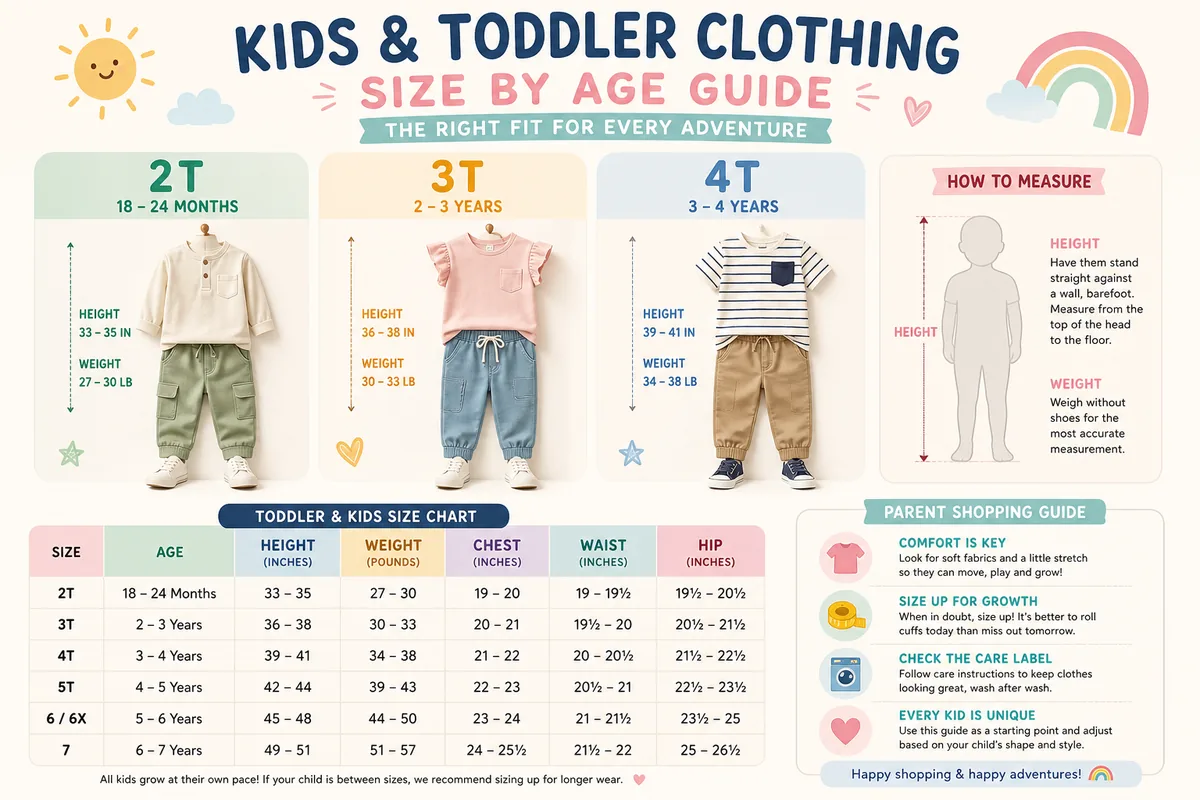
Kids sizes (US / UK / EU)
| US | UK | EU | Height | Chest |
|---|---|---|---|---|
| 0-3m | 0-3m | 62 | 62 cm~24 in | 43 cm~17 in |
| 3-6m | 3-6m | 68 | 68 cm~27 in | 46 cm~18 in |
| 6-9m | 6-9m | 74 | 74 cm~29 in | 47 cm~19 in |
| 9-12m | 9-12m | 80 | 80 cm~31 in | 48 cm~19 in |
| 2T | 18-24m | 92 | 86 cm~34 in | 52 cm~20 in |
| 3T | 2-3y | 98 | 95 cm~37 in | 54 cm~21 in |
| 4T | 3-4y | 104 | 102 cm~40 in | 56 cm~22 in |
| 5 | 4-5y | 110 | 110 cm~43 in | 58 cm~23 in |
| 6 | 5-6y | 116 | 115 cm~45 in | 59 cm~23 in |
| 7 | 6-7y | 122 | 120 cm~47 in | 61 cm~24 in |
Kids clothing sizes after toddler
US kids sizes run 4, 5, 6 … 14 then juniors. Even sizes common (6, 8, 10). Size 6 fits ~45–47" height roughly ages 5–6 but height chart beats age.
Slim and husky variants add width at same height size.
US kids size chart
| Size | Height in | Weight lb | Age guide |
|---|---|---|---|
| 6 | 45–47 | 42–48 | 5–6 |
| 8 | 49–51 | 52–62 | 7–8 |
| 10 | 53–55 | 62–74 | 9–10 |
| 12 | 56–58 | 74–86 | 11–12 |
| 14 | 59–61 | 86–100 | 13–14 |
Kids fit notes
- Husky: same height smaller size with wider waist.
- Slim: longer limb same age, narrower.
- EU 128 cm (~50.0 in) ≈ US size 8 height band.
- School uniforms—match chest and waist cm on vendor chart.
Pick kids clothing size
- 1
Height and weight
Use brand chart primary column.
- 2
Check slim/husky
If waist tight in regular, switch cut not only size.
- 3
Layer room
Winter +0.5 size or one size up coat only.
- 4
Shoe independent
See kids shoe chart separately.
Kids clothing mistakes
Avoid: Age 8 = size 8 always
Instead: Height 50" may need 7 or 8.
Avoid: Adult XS for fast growers
Instead: Adult cut long sleeve wrong proportions.
Avoid: Same size tops and bottoms
Instead: Bottoms may differ if long torso.
School uniforms and sports
Uniform vendors publish chest and waist cm—school letter size may not match mall brands.
Sports kits (soccer, baseball) often size by age then height—check both columns.
Pre-teen overlap with adult XS starts near size 14–16 depending on brand grading.
Return or exchange workflow
- 1
Keep packaging
Boxes and hang tags speed refunds when size is wrong.
- 2
Try indoors only
Scuffed soles or worn labels may void returns.
- 3
Document fit issue
Photo of pinch point or heel gap helps support.
- 4
Reorder fast movers
Half sizes and popular EU widths sell out during sales.
More kids clothing size by age questions
- Should I size up when between chart rows?
- Non-stretch and leather usually need the larger row; stretch fabrics may take the smaller.
- Do regional sites use different charts?
- Yes—US, EU, and Asia storefronts sometimes grade differently for the same SKU.
- How often to remeasure?
- Feet: twice a year or after weight change; kids: every 2–3 months; bras: after body changes.
- Are marketplace sellers reliable for size?
- Authorized retailers match brand charts; third-party listings may be old season lasts.
- Where to start with feet?
- See how to measure shoe size before converting sizes.
Real-world notes on kids clothing size by age
Charts for kids clothing size by age summarize typical grading—they are not a guarantee for every season or factory run. When a brand refreshes a last or fit block, reviews often mention it before charts update.
Marketplace listings may ship mixed inventory. Compare the size stamped inside the item on delivery with the chart row you used at checkout.
If you are gifting, ask for body or foot measurements in cm instead of guessing their usual tag size. Gift returns are harder when wear signs appear.
Sales associates can measure you in store; take a photo of the store chart if you later order online from the same brand.
Between online orders, remeasure if your weight changed, you had a foot injury, or you switched sock or insole thickness for running.
Teaching kids their cm size helps them shop later—write foot length inside closet door as a reference.
Document the date you measured—repeat after pregnancy, injury, or major weight change so old numbers do not linger in notes apps.
Measurement hygiene
- Stand weight evenly on both feet when tracing outlines.
- Measure twice on different days if you are between rows.
- For clothing, wear the undergarments you will use with the piece.
- For shoes, match sock thickness to intended use.
- Convert using cm first, then read US/UK/EU from the row—never reverse the order.
- Keep a saved note on your phone with your foot cm and bust/waist/hip cm.
- Update kids' sizes every growth spurt—do not buy multiple seasons ahead.
- Check whether reviews mention 'runs small' for the exact model you chose.
- Prefer free-return windows when trying a new brand last.
- Wide feet: try width SKUs before adding length—see 2E vs 4E shoe width.
Common kids clothing size by age errors
Avoid: Using an old size tag from a different brand
Instead: Measure today and match the chart row for this category.
Avoid: Rounding down cm to stay in a smaller letter size
Instead: Round to the row that fits your longer foot or largest body measure.
Avoid: Ignoring half sizes or wide widths
Instead: Half steps and 2E/4E widths fix fit better than guessing.
Avoid: Assuming sales charts match outlet or marketplace stock
Instead: Verify inside label on delivery against the chart you saved.
Extra kids clothing size by age answers
- Online vs in-store size the same?
- Usually yes for current season full-price items; outlets and older stock may differ slightly.
- Do I need to convert if the site shows multi-scale?
- Pick the column you shop in, but confirm your cm or inch measure lands on that row.
- Should athletes size up?
- Running and court sports often need thumb-width toe room—see running shoe size fit.
- Are charts unisex?
- Only when labeled unisex—otherwise use men's and women's tables separately.
- What if half my foot measures between rows?
- Use the longer foot and the larger measure among bust, waist, and hip for clothing.
Kids clothing FAQ
- Kids size 8 measurements?
- Height ~49–51", weight ~52–62 lb typical.
- Size 7 vs 8?
- One height step ~2 inches apart on charts.
- EU 140 cm (~55.0 in) kid?
- Often US 10 height range.
- Husky size 10?
- Waist of husky 10 near regular 12, height of 10.
- Teen 14 vs adult XS?
- 14 fits child proportions; XS adult long and narrow shoulder.
FAQ
- What clothing size is a 5-year-old?
- Many 5-year-olds wear US size 5–6 with height near 110–115 cm on our chart. Measure height and chest—active kids may need size 6 for length while chest still fits 5.
- What size is a 7-year-old boy or girl?
- Often US 7 or youth XS with height near 120 cm. Boys and girls use the same numeric kids sizes on most charts; fit differs by cut, not gender label.
- When do kids switch to youth sizes?
- Many brands switch to youth XS–XL around height 130–140 cm (often ages 8–12). Youth M is not the same as adult M—always check chest cm on the youth chart.
- Should I size up kids clothes for growth?
- Size up one step for seasonal outerwear if between rows. Everyday tees and leggings should fit now—over-sizing causes tripping on cuffs and shoulders.