
Underseat Luggage Size Guide
This guide helps you choose an underseat personal item that fits airline rules and avoids last-minute boarding rejection.
Airline limits last checked 2026-08-30.
Primary Rule
Your personal item must fit fully under the seat in front of you.
Common Failure Point
Bag depth increases after overpacking and fails under-seat fit.
Best Strategy
Choose a soft, compressible bag and keep a small size buffer.
Practical Underseat Checklist
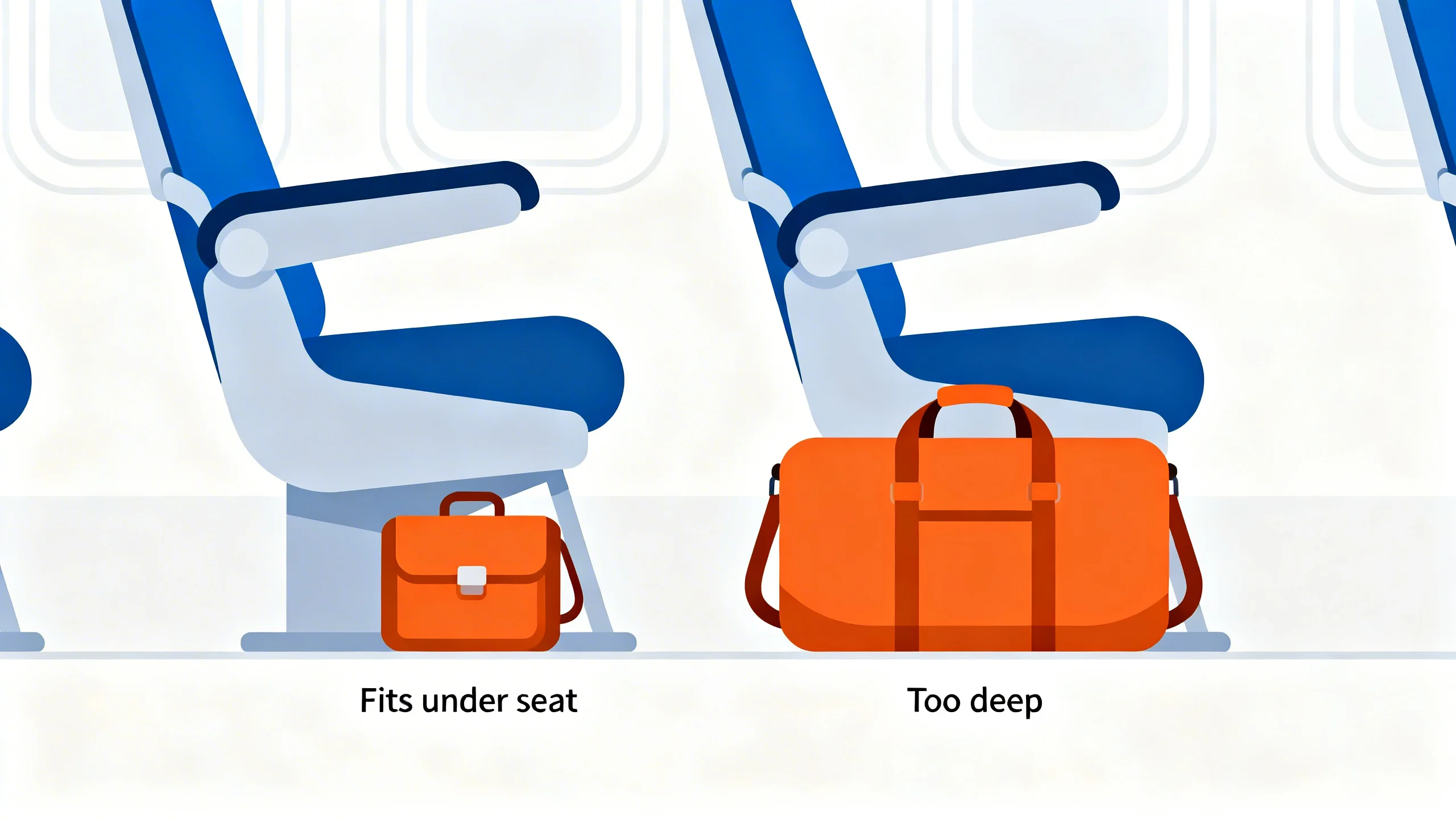
- Check airline-specific personal item dimensions when available.
- Avoid rigid front pockets if you usually pack to full capacity.
- Place passport, medication, charger, and valuables in this bag.
- Test-fit the packed bag under a chair at home to simulate seat clearance.
Airline Personal Item Examples
Not every airline publishes exact dimensions. Use this table as a fast reference, then verify your final policy by route and fare.
Swipe horizontally to view full table
| Airline | Published Personal Item Size | Rule Pattern |
|---|---|---|
| Delta Air Lines | Not strictly published in one fixed size block | Must fit under seat |
| American Airlines | 18 x 14 x 8 in | Under-seat fit is the core requirement |
| United Airlines | 17 x 10 x 9 in | Under-seat fit is the core requirement |
| JetBlue | 17 x 13 x 8 in | Under-seat fit is the core requirement |
| Frontier Airlines | 18 x 14 x 8 in | Under-seat fit is the core requirement |
Quick Facts
Personal-item / underseat bags are smaller than carry-on—check your airline's published size.
- Underseat rule type
- Personal item must fit fully under seat in front
- Dimension policy pattern
- Some airlines publish exact size, others only under-seat fit requirement
- Most common fail reason
- Excess depth from overpacking or rigid front pockets
- Best practice
- Use compact flexible bags and keep a small size buffer
How Airlines Calculate Luggage Size
Airline baggage limits in inches are based on the outer box dimensions of your bag, not volume.
- Carry-on rule (most common): single-side limits such as 22 x 14 x 9 in (L x W x H).
- What must be included: wheels, handles, feet, and any rigid external parts.
- What is not used as the main rule: liters/cubic volume is usually not the acceptance criterion.
- Sizer logic at airport: if the bag does not fit the frame, it can be denied or gate-checked.