
How to Measure Luggage Size
This guide explains exactly how airlines measure carry-on and checked bags, and how you can measure at home to avoid gate-check and fee surprises.
Limits last checked 2026-08-30.
Measure Outside
Always measure the outer shell, never only the interior capacity.
Include Protrusions
Wheels, handles, feet, and hard pockets must be included.
Use Buffer
Leave 1-2 cm margin because airport sizers are rigid and strict.
Step-by-Step Measurement Process
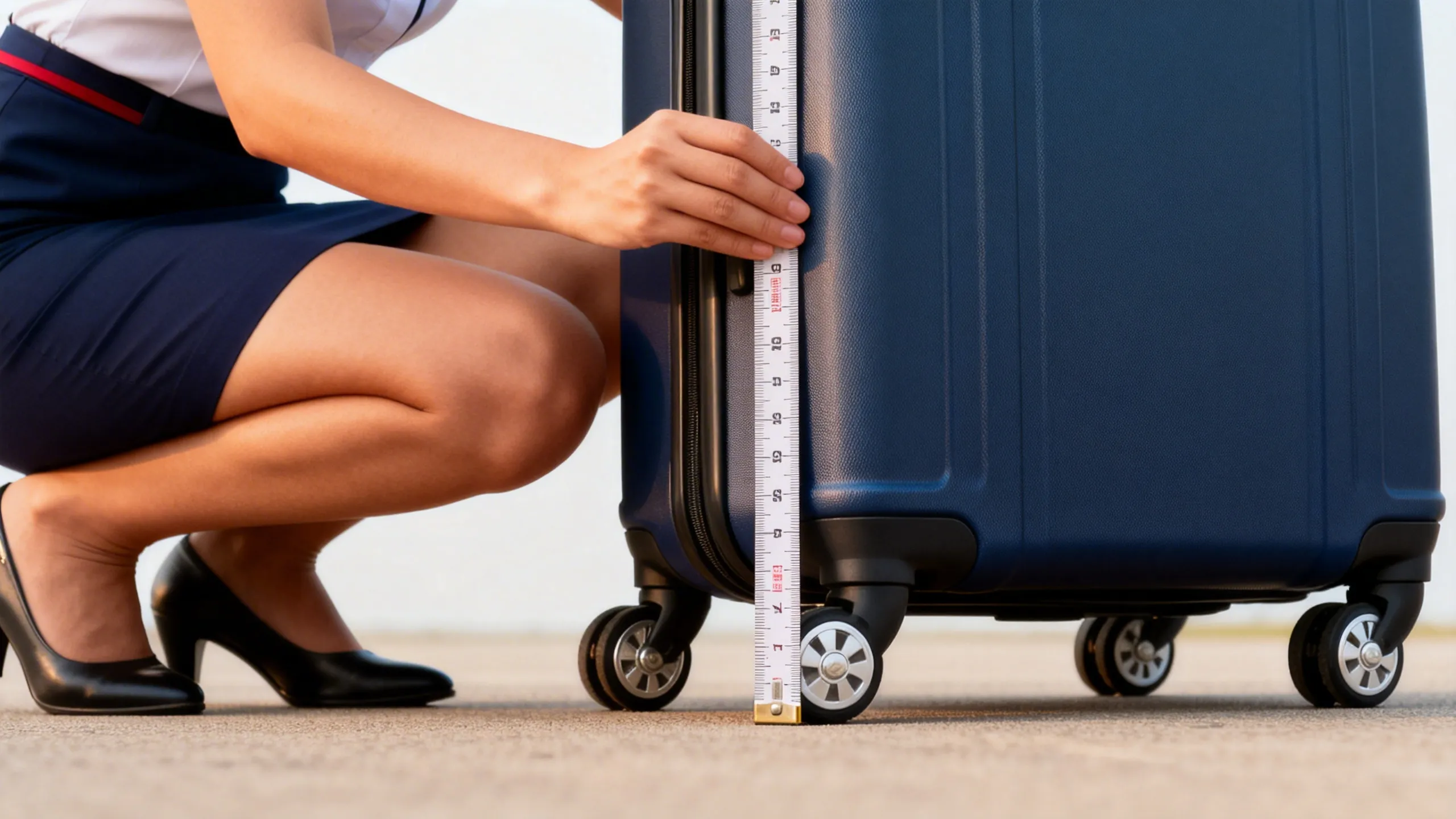
Measure the outer shell and include wheels, handles, and rigid external parts.
- Place luggage upright on a flat floor.
- Measure height from floor to top handle/wheel point.
- Measure width at the widest side point.
- Measure depth from front shell to back shell including pockets.
- Calculate linear size: length + width + height.
How Airlines Calculate Luggage Size
Airline baggage limits in inches are based on the outer box dimensions of your bag, not volume.
- Carry-on rule (most common): single-side limits such as 22 x 14 x 9 in (L x W x H).
- What must be included: wheels, handles, feet, and any rigid external parts.
- What is not used as the main rule: liters/cubic volume is usually not the acceptance criterion.
- Sizer logic at airport: if the bag does not fit the frame, it can be denied or gate-checked.
For checked baggage, many airlines use linear size: L + W + H. Example: 30 + 20 + 12 = 62 linear inches.
Quick Facts
Citation-ready measurement rules for carry-on and checked baggage.
- Measure from
- Outer shell, not interior compartment
- Include parts
- Wheels, handles, feet, rigid pockets
- Carry-on check method
- Compare each side against airline limit
- Checked-bag check method
- Use linear size = L + W + H
- Safe margin suggestion
- Leave 1-2 cm buffer below max limit
Linear Size Calculation Example
Example checked bag dimensions: 30 in (L) + 20 in (W) + 12 in (H) = 62 linear inches.
This is why many 30-inch class suitcases can quickly hit the common 62-inch checked threshold.
Common Measurement Mistakes to Avoid
- Measuring fabric shell only and ignoring wheel height.
- Using product “capacity liters” as if it were airline acceptance criteria.
- Measuring an empty bag, then overpacking and changing depth.
- Skipping final re-check before return flight after shopping.