
Carry On Luggage Size Guide
Use this page to verify carry-on limits in inches and centimeters, compare typical luggage size bands, and jump to airline-specific rules.
30-Second Decision Module
- Measure outer shell (include wheels and handle).
- Run multi-airline check to see pass/fail and exact failure reason.
- If fail appears, follow the action advice before checkout or departure.
Swipe horizontally to view full table
| Size Band | Inch Range | Volume (L) | Best For |
|---|---|---|---|
| Carry-on Small | 18-20 | 30-45 | 1-3 days |
| Carry-on Standard | 20-22 | 35-50 | 2-5 days |
| Medium Checked | 24-26 | 60-90 | 5-10 days |
| Large Checked | 28-32 | 95-130 | 10+ days |
Quick Facts
Common US carry-on benchmark: 22 x 14 x 9 in (56 x 36 x 23 cm). Airline policy is final.
- Common carry-on benchmark
- 22 x 14 x 9 in (56 x 36 x 23 cm)
- Who defines final carry-on size
- Airline policy (not one global TSA dimension)
- Main measurement method
- Outer dimensions by side length, including wheels and handles
- Volume used as final acceptance rule
- Usually no
- Primary risk near limit
- Gate-check due to strict sizer or limited overhead space
How to Measure Before You Compare Limits
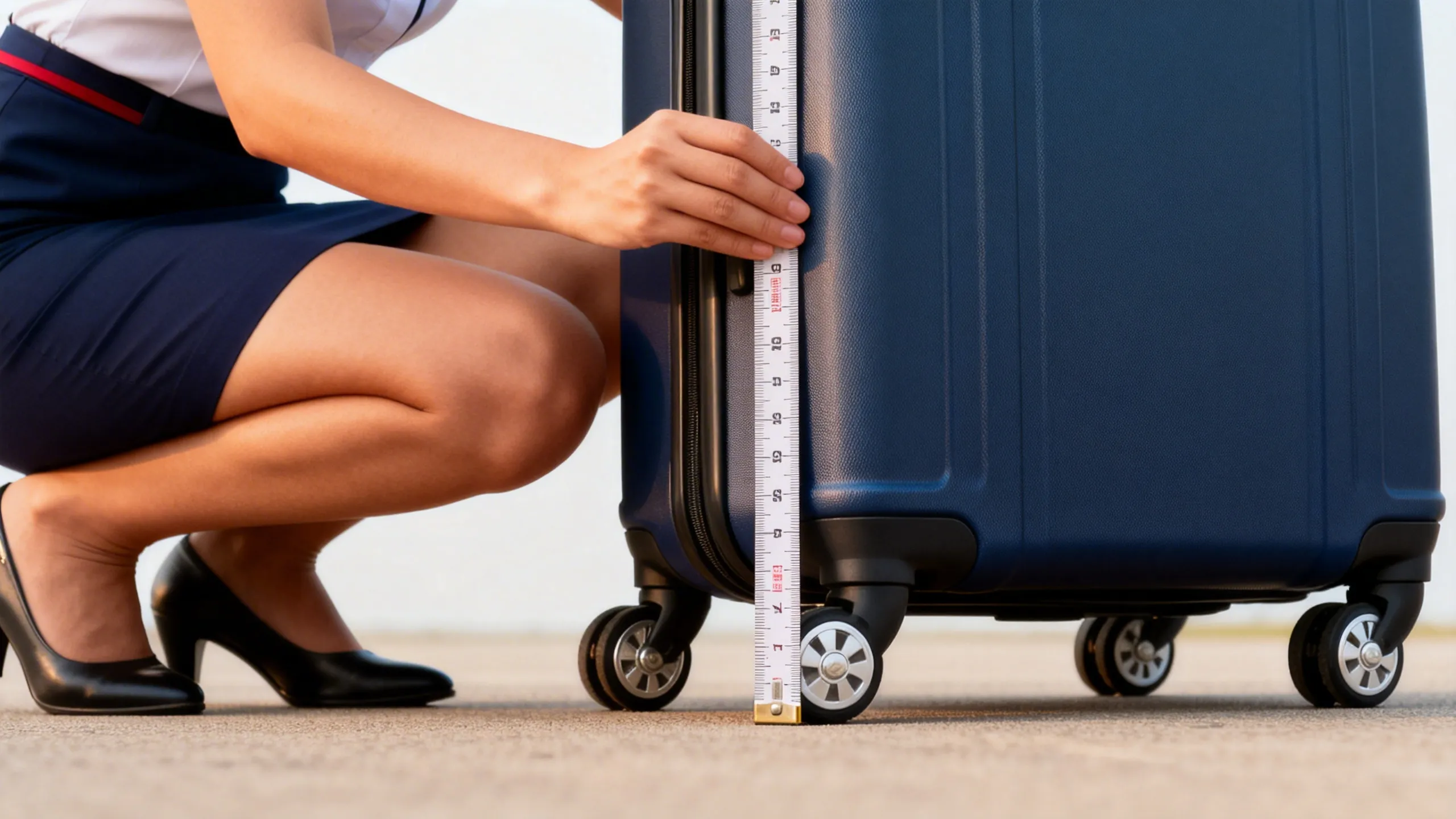
Measure the outer length, width, and height before checking airline limits.
Always include wheels and handles, because this is how airport sizers evaluate your bag.
See full measurement guideAirline baggage limits in inches are based on the outer box dimensions of your bag, not volume.
- Carry-on rule (most common): single-side limits such as 22 x 14 x 9 in (L x W x H).
- What must be included: wheels, handles, feet, and any rigid external parts.
- What is not used as the main rule: liters/cubic volume is usually not the acceptance criterion.
- Sizer logic at airport: if the bag does not fit the frame, it can be denied or gate-checked.
Quick Airline Carry-on Comparison
These examples cover the most searched US airlines. Always verify your exact route and fare before departure.
| Airline | Carry-on (in) | Carry-on (cm) | Notes |
|---|---|---|---|
| Delta Air Lines | 22 x 14 x 9 | 56 x 35 x 23 | official |
| American Airlines | 22 x 14 x 9 | 56 x 36 x 23 | official |
| Southwest Airlines | 24 x 16 x 10 | 61 x 41 x 25 | official |
| United Airlines | 22 x 14 x 9 | 56 x 35 x 23 | official |
Most Common Carry-on Benchmark
Many US airlines use 22 x 14 x 9 in (about 56 x 36 x 23 cm), including wheels and handles.
TSA guidance confirms that carry-on dimension rules vary by airline, so you should treat this as a starting point, not a guaranteed pass.
On smaller regional aircraft, even compliant bags can be gate-checked due to overhead space limits.
How to Avoid Gate-check Problems
- Leave a 1-2 cm safety margin; a bag at exact maximum can fail rigid sizers.
- Do not overfill front pockets; depth is the most common fail point.
- Pack essentials (passport, medication, chargers) in your personal item in case of forced gate-check.
How to Choose the Right Carry-on Size for Your Trip
For 1-3 day trips, 18-20 inch bags are safer across strict carriers and smaller aircraft. For 3-5 day trips, 20-22 inch bags are practical if you pack efficiently.
If you often fly regional routes, prioritize slightly smaller shells and softer materials because strict bin space can force gate-check even when your bag is close to the limit.
If your fare type has restrictions, use a personal item-first strategy and keep high-value essentials with you.
Related Pages
- TSA carry-on size FAQAirline site · Last checked: 2026-08-30https://www.tsa.gov/travel/frequently-asked-questions/what-are-size-restrictions-carry-bags
- Delta Air Lines carry-on policyAirline site · Last checked: 2026-08-30https://www.delta.com/us/en/baggage/carry-on-baggage
- American Airlines carry-on policyAirline site · Last checked: 2026-08-30https://www.aa.com/web/i18n/travel-info/baggage/carry-on-baggage.html
- Southwest Airlines carry-on policyAirline site · Last checked: 2026-08-30https://www.southwest.com/html/customer-service/travel-fees.html
- United Airlines carry-on policyAirline site · Last checked: 2026-08-30https://www.united.com/en/us/fly/baggage/carry-on-bags.html