
Carry-on Luggage Size in CM
Use this guide to convert common carry-on sizes to centimeters, compare major airline examples, and understand how dimension checks actually work at airports.
Common CM Baseline
56 x 36 x 23 cm is a widely used carry-on benchmark.
Main Check Logic
Airlines check outer side dimensions and sizer fit, not only liters or capacity labels.
Best Practice
Keep a small margin below the maximum size to reduce gate-check risk.
Quick Facts
Common carry-on benchmark: 56 x 36 x 23 cm. Airlines enforce outer dimensions, not liters.
- Common carry-on metric baseline
- 56 x 36 x 23 cm
- Primary validation method
- Single-side dimensions and sizer fit
- Volume as acceptance rule
- Usually not the final airline acceptance criterion
- Final authority
- Airline policy for your route and fare type
Inch to CM Carry-on Conversion Table
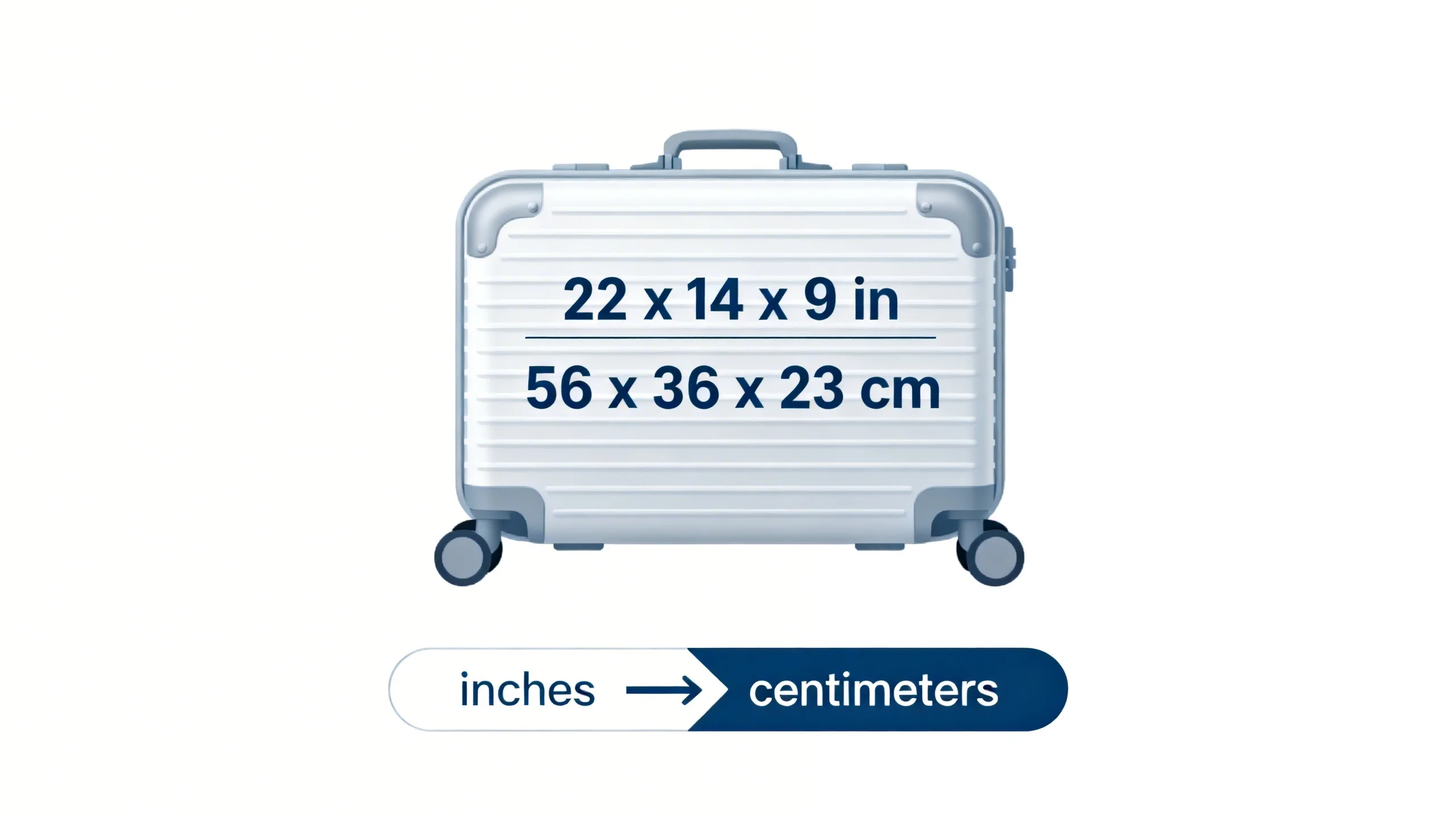
Many airline pages still publish dimensions in inches. This quick table helps you convert the most common carry-on sizes to centimeters.
Swipe horizontally to view full table
| Carry-on Size (in) | Carry-on Size (cm) | Usage Note |
|---|---|---|
| 22 x 14 x 9 | 56 x 36 x 23 | Most common US benchmark |
| 24 x 16 x 10 | 61 x 41 x 25 | Used by some airlines |
| 21.5 x 13.5 x 9 | 55 x 34 x 23 | Common safer compact size |
Major Airline Examples in CM
These examples help you estimate quickly, but always confirm the final rule on your airline policy page before flying.
Swipe horizontally to view full table
| Airline | Carry-on (cm) | Carry-on (in) | Personal Item Rule |
|---|---|---|---|
| Delta Air Lines | 56 x 35 x 23 | 22 x 14 x 9 | Must fit under seat |
| American Airlines | 56 x 36 x 23 | 22 x 14 x 9 | See airline specific dimension rule |
| Southwest Airlines | 61 x 41 x 25 | 24 x 16 x 10 | One personal item free, under-seat fit required |
| United Airlines | 56 x 35 x 23 | 22 x 14 x 9 | See airline specific dimension rule |
| JetBlue | 55.9 x 35.6 x 22.9 | 22 x 14 x 9 | See airline specific dimension rule |
How Airlines Calculate Luggage Size
Airline baggage limits in inches are based on the outer box dimensions of your bag, not volume.
- Carry-on rule (most common): single-side limits such as 22 x 14 x 9 in (L x W x H).
- What must be included: wheels, handles, feet, and any rigid external parts.
- What is not used as the main rule: liters/cubic volume is usually not the acceptance criterion.
- Sizer logic at airport: if the bag does not fit the frame, it can be denied or gate-checked.
How to Choose a CM-Safe Carry-on
- For strict routes, prioritize 55-56 cm class bags instead of edge-limit models.
- Soft-shell designs can reduce fit failures when bins are tight.
- Do not overfill external pockets; depth growth is a common rejection reason.
- Re-check dimensions before return flights because overpacking changes shape.